Coach -
Split-field coverage gives you two different coverages on the same snap. One side plays bracket. The other side plays man-match. The offense doesn't get to dictate one coverage solution for the whole field because each side of the defense is answering a different question.
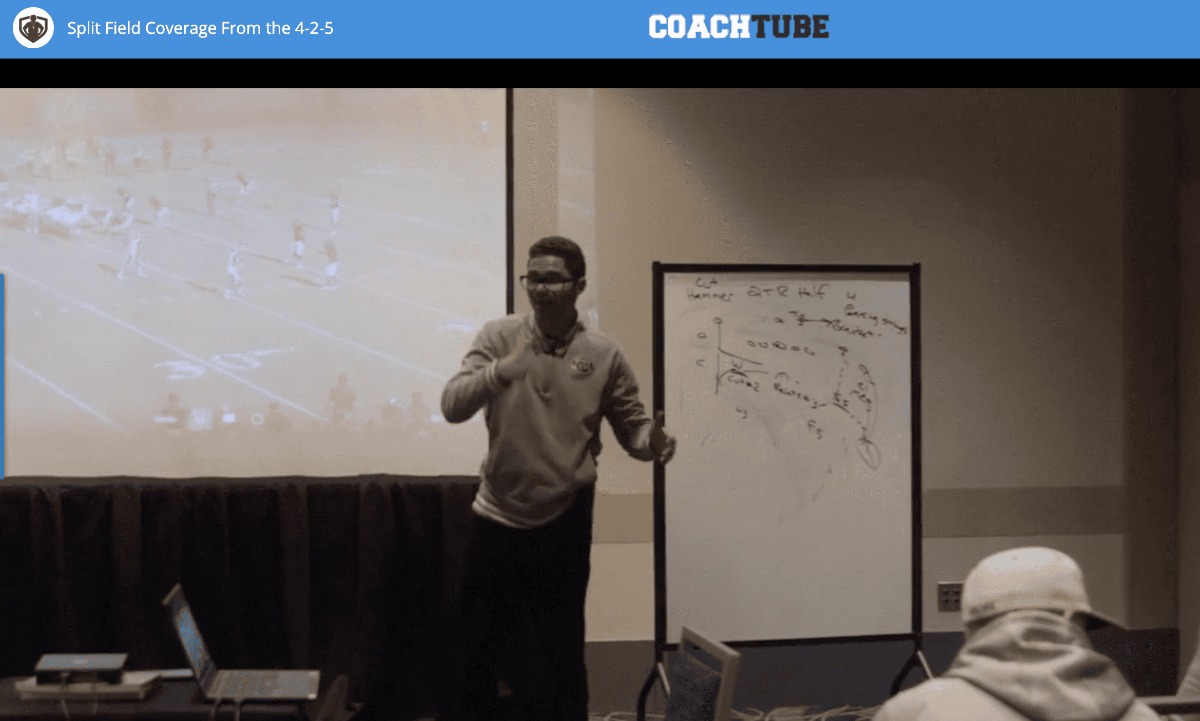
Dante Bartee, Defensive Assistant at the University of Oregon, breaks down his split-field structure from the 4-2-5. In this clip, he covers the Hammer principle, the corner's flat defender technique, and how the Mike connects both halves of the coverage.
Video: Dante Bartee - Split-Field Coverage from the 4-2-5
Two Sides, Two Coverages
The split-field concept divides the defense at the ball. One side plays bracket. The other side plays what Bartee calls Hammer.
On the bracket side, the coverage is built around spot fade. The corner plays outside trail on number one. The safety plays inside on top. If number two goes vertical, the defense doubles two and the corner handles one by himself. If two is not vertical, they find a way to double one.
On the Hammer side, it's a man-match version of two-high coverage. Bartee puts it in the Cover 5 family. Not Cover 4, not Cover 7. Cover 5. That label tells his players the principles they're operating with, and it delineates it cleanly from zone-match two-high (Cover 2, Cover 8) and zone-match one-high (Cover 3).
The Mike linebacker ties both halves together. He's what Bartee calls a relate-to-three player. Man to man on the number three receiver, which is the running back. If the back blocks, the Mike goes and hugs him. If the back is fast to the flat on the bracket side, the Mike pushes to find the new three. Whoever fills that spot, whether they run vertical or run a snag, the Mike plays them man to man. No zone eyes anywhere on this coverage.
The Cut Principle: Building the Fence from the Bottom Up
On the Hammer side, the Will backer is the key. His job is to cut on number two.
The rules are clean:
- Two goes up or inside: Man to man. Inside trail, half turn, hinge. Let two win the race vertically. Maintain position inside. If two runs a shallow or goes inside, take him man to man. No passing off.
- Two goes out: Cut the one. Build the fence from the bottom to the top.
That second part is where the teaching gets specific. Bartee calls it the reverse robber principle. In robber, you build the fence from top to bottom. Here, you're doing the exact same thing, just from the bottom up. The Will snaps his eyes to number one, runs to build the fence, and on the end break, hunts the hip and picks it.
The teaching progression is the same one Bartee uses for robber. Same eye discipline. Same fence mechanics. Same hip-and-pick finish. The only difference is the direction. Bartee walks through the movement and the reads in the clip above.
The Corner as Flat Defender in Hammer
This is where the technique gets detailed. In Hammer, the corner is not playing man on one. He's the flat defender.
Alignment: Four to five yards off, one yard inside number one. Inside leverage.
Footwork: Bartee teaches a squat or funnel technique. The corner moves with the opposite foot of the receiver's release. If the receiver goes outside, the corner steps with his inside foot first. It's like a basketball slide. If you step with your outside foot, you lose your base and the receiver crosses you over.
The corner posts the receiver with his near hand and carries him through the fade area, working an angle pedal the same way a flat defender works in skate technique. Once the receiver gets outside the corner's framework, the corner opens and holes to about 15 to 18 yards.
The hang rule: If number two or three comes to the flat at any point, the corner hangs. Feet tight to the ground. Don't drive on the flat receiver until the ball takes you to him. Bartee's cue: "Ball takes you high, I fly. Ball takes you low, I go."
The system works because every defender has one set of rules and no zone eyes. The Will cuts on two or builds the fence on one. The corner carries through the fade area and hangs when the flat declares. The Mike relates to three. Each player's job is man-match with clear triggers, not option reads against route combinations.
Always be growing,
Coaches Clinic Community of Coaches Helping Coaches
P.S. Bartee's full clinic, Split-Field Coverage from the 4-2-5, goes beyond the Hammer principle.
He covers the bracket side in depth, alignment adjustments, Stubby and Connie coverage variations, communication systems for the secondary, and game film connecting all of it to live execution.
If you're running a 4-2-5 or looking to add split-field concepts, the full clinic is at the link below:
0 comments