Coach -
Fire zones give you five-man pressure with zone coverage behind it. You know that. The question is whether your players know exactly what they're doing when you call one.
This week's breakdown features three coaches who each handle a different piece of the fire zone puzzle. Adam Harvey builds the pressure structures. Jawan Turner teaches the coverage responsibilities. Jason Bornn dials in the execution details on a specific pressure path.
Different pieces, same goal: everyone knows their job before the ball is snapped.
Adam Harvey's Creeper Fire Zones: Pressure Structures and When to Use Them
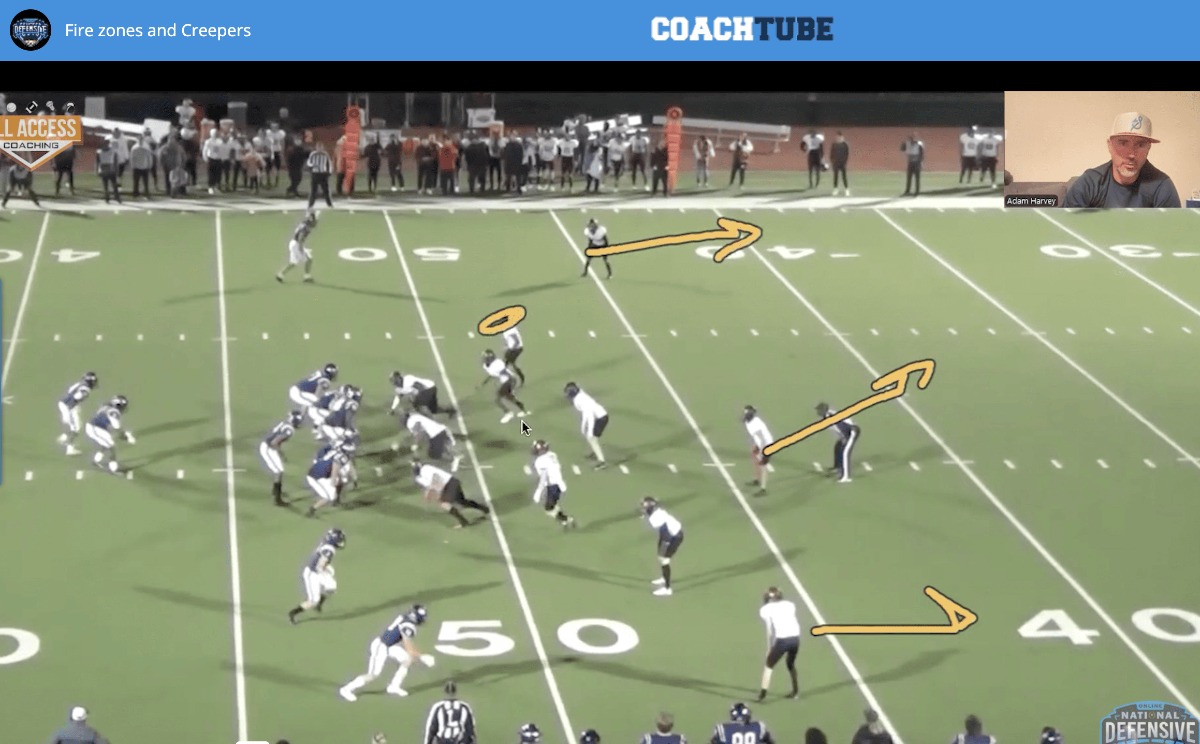
Adam Harvey, Head Coach at Long Creek H.S. (TX), runs his fire zones out of middle-field-closed concepts. Whether you're playing pattern match or country coverage, these pressures fit.
His first look is what he calls Bolt—two linebackers from the same side of the field. Harvey likes this when he wants to flush the quarterback from field to boundary. The down safety replaces one of the blitzing linebackers, giving you three-deep, three-under behind five-man pressure.
Harvey emphasizes that the seam-curl-flat player needs to be slow. He can hang in the RPO window, especially from the blitzing side, because you might get a hot throw.
The remaining underneath defender plays low hole, all sides. With two linebackers gone, he's looking for crossers and sitters, getting hands on anyone who enters his area.
His second structure brings two off the edge with the down safety replacing underneath. Against a 3x1 set, the free safety closes the middle of the field. Against 2x2, it plays more like middle-field-open, but Harvey still treats it as a fire zone because you're running match coverage, not pure man.
Harvey makes an important distinction: the creeper element is what separates this from a standard blitz. Someone comes from a conventional second-level spot and puts a foot in the gap to get a head start before the snap while a traditional lineman drops.
Jawan Turner's Coverage Rules: Teaching the Underneath Responsibilities
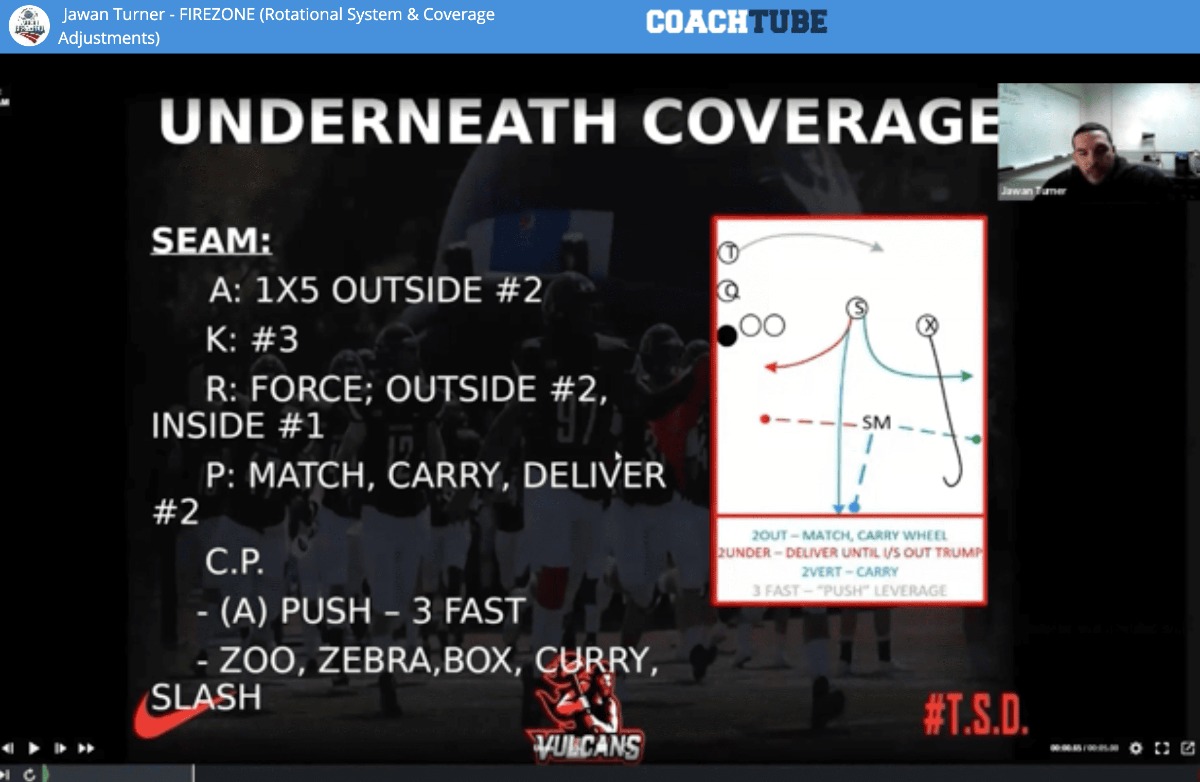
Jawan Turner, Defensive Coordinator at California University of Pennsylvania, installs fire zone coverage through concepts before plays.
At the center of his teaching is a pre-snap checklist he calls AKRP. Before every snap, his underneath defenders run through it: Alignment, Key, Responsibility, Post-snap progression.
Where do I line up? Who do I read? What's my job based on that key? How do I adjust after the snap?
It sounds simple, but that's the point. Turner's players aren't memorizing a call sheet. Instead, they're learning a framework that adapts to what the offense shows them.
His seam player aligns one-by-five outside of number two with eyes on number three. Against the run, he's the force player fitting outside of two, inside of one.
Against the pass, he reads number two and reacts:
- Two out: Match it, carry the wheel on the upfield shoulder.
- Two under: Squeeze to deliver, looking for something coming back across his face.
- Two vertical: Carry on the outside low hip, trusting post-safety help.
When number three goes fast, what Turner calls a push, the seam player expands deep to short. There's a route in front of him, but he can't chase it. Stay deep, let the hook player and safety work over to the sail or tear behind it.
His three-middle-hook player aligns inside number three with eyes on three.
He's the final-three player in the pass game, and his reads work the same way:
- Three under: Match it inside-out.
- Three vertical: Wall it with eyes on two and look to rob the quick slam and tighten the throwing window.
- Three fast: Push the seam deep-to-short, then build eyes from two to one.
That last read is where Turner's route recognition teaching shows up. When three goes fast, his defenders know what's coming: snag, dagger, tear, or spacing. They shift their eyes accordingly.
"If three goes fast, our eyes go to two," Turner said. "If two is pushing vertical, what's one doing? If one's on a snag, that's ours. If he's going vertical, now we're looking for that dagger behind it."
The payoff is speed. Turner's players react fast because they see the game clearly, and not because they memorized every possible call.
Jason Bornn's Wham Mechanics: A Pressure Path That Executes Clean
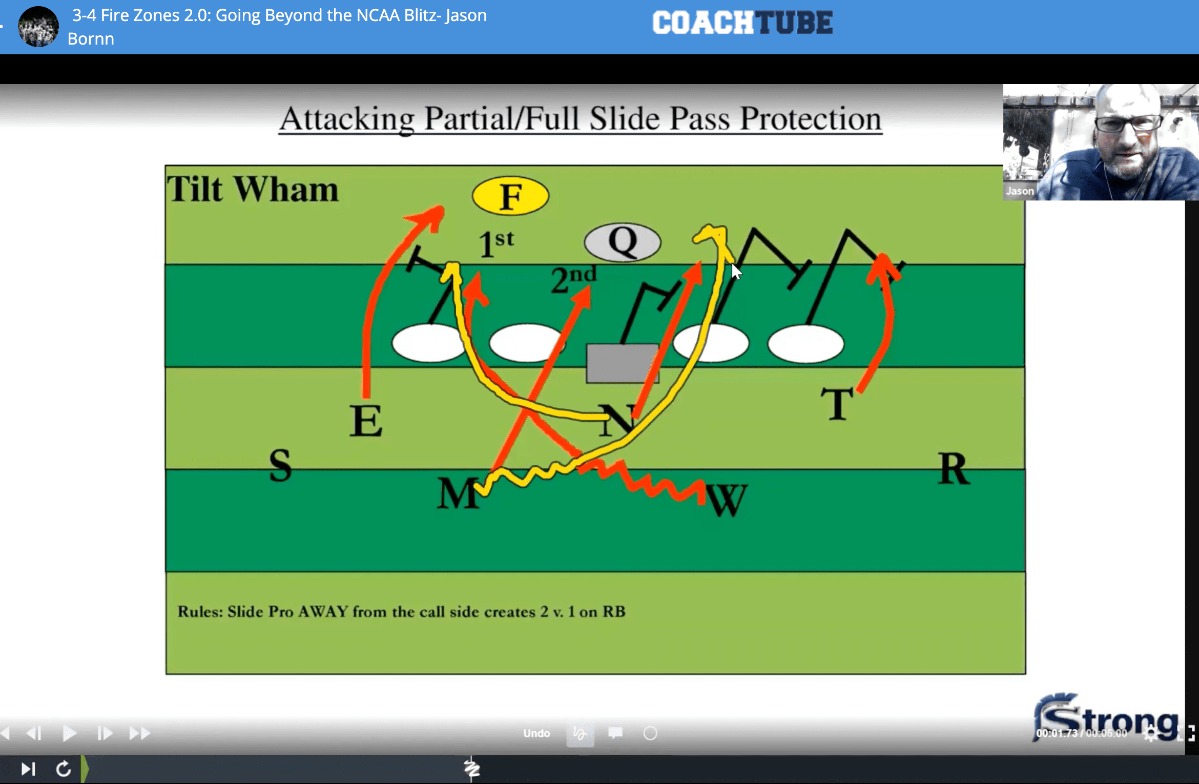
Jason Bornn, Head Coach at Saugus H.S. (CA), breaks down a specific pressure path: the Mike and Will cross, which he calls Wham.
Bornn sends the Mike first, Will second. Here's why. His original version had the nose slanting to the B gap, Mike through the near-side A, Will through the back-side A—one, two, three. The problem was the center would chase the slanting nose, the guard would close down, and there was no hole for the Will to come through.
Wham solved it. The nose goes, the Mike goes first, the center ends up on one, the guard ends up on the other, and the Mike comes clean against the running back. Bornn will take that matchup every time—inside linebacker on a back.
On film, you can see his Will and Mike communicating before the snap. Bornn points out that number 43 is literally telling number 24, "You go first, I'll go second." Some coaches might worry about tipping the pressure. Bornn's take: he doesn't care if the offense knows what's coming. He cares that his guys know what they're doing.
The execution details: the first backer through is your spill-chaser. He triggers, goes, then chases the play from the front side. The second backer fills the open gap and makes the play.
Bornn's point isn't complicated, but it matters: if you're crossing two linebackers, they need to know who's going first. Get that wrong and you've got two guys in the same gap with nobody in the other. Get it right and you're putting a linebacker on a running back with a free run at the quarterback.
Three different pieces of fire zone execution.
Harvey gives you the pressure structures and the timing that makes creepers work. Turner gives you the coverage rules that keep everything sound behind the blitz. Bornn gives you the details that make your pressure path execute clean.
The common thread: everyone knows their job. When you call a fire zone, your players shouldn't be guessing. They should be communicating, triggering, and executing because you've already taught them the pieces.
Always be growing!
Coaches Clinic Community of Coaches Helping Coaches
0 comments