Coach -
Spring ball is when you install the stuff that needs reps before it shows up on Friday night. Schemes are part of that. But before you put in a single stunt or movement call, your players need to understand why they're moving. What the movement is trying to accomplish. What it looks like when it works. And what the defense is trying to force the offense into on the other side of it.
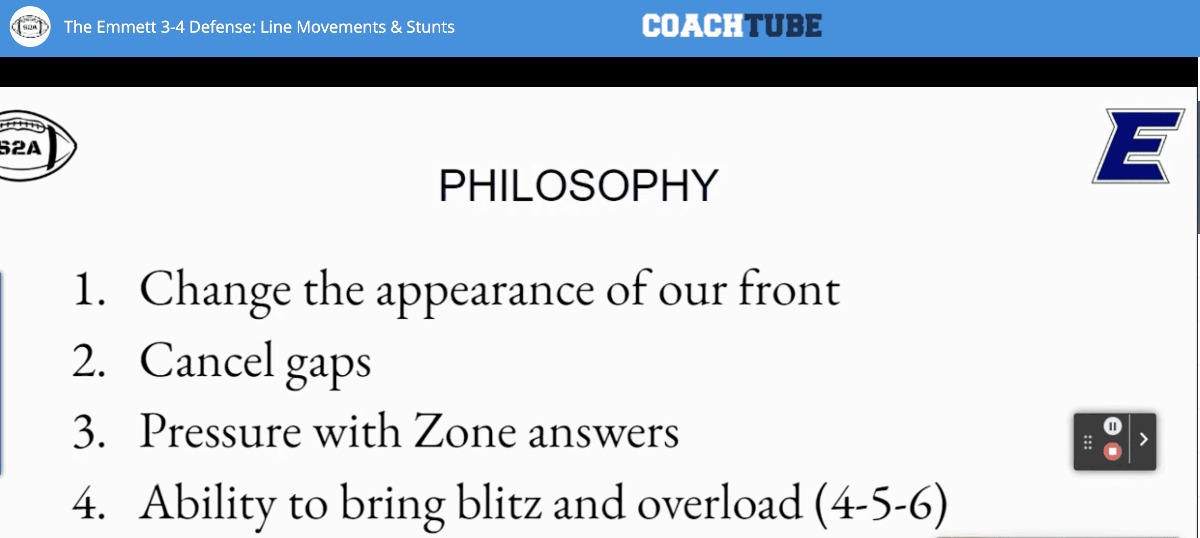
Coach Rich Hargitt lays out the philosophy behind line movements and stunts in his Emmett 3-4 Defense system. This isn't the playbook. This is the thinking that makes the playbook work. And it's the kind of thing that's worth getting in front of your guys early, before you start drilling specific calls.
Video: Rich Hargitt - The Emmett 3-4 Defense: Line Movements & Stunts
The Goal Isn't Havoc. The Goal Is Gap Cancellation.
Coach Hargitt is clear about the hierarchy. Yes, you want TFLs. Yes, you want D-linemen in the backfield. But that's not the primary purpose of the movement.
The primary purpose is canceling gaps.
"We want to take D-linemen and move them from one place to the other. We want to cancel out a gap, maybe two gaps with our body and our movement and our path, and then be able to run linebackers free to the point of attack."
That's the framework. The defensive line moves to take gaps away. When gaps disappear, the offensive line's blocking rules break down. And when the blocking rules break down, linebackers run free to the football and make tackles. Stops at the line of scrimmage. Minimal gains. First and second down wins that put the offense in a hole.
The havoc plays are a bonus. Gap cancellation is the job.
Change the Picture, Then Change It Again
Before the ball is snapped, the defense has already started working. Coach Hargitt wants his front to line up in a base structure and then immediately change the appearance. A 4-0-4 look, a standard husky or oaky alignment, something the offensive line has seen on film and prepared for.
Then the movement changes it.
The offensive line identifies the front, makes their calls, and sets their combination blocks. The movement changes the math. The guard who was supposed to combo to the linebacker is now dealing with a lineman who wasn't in his gap a second ago. The center who was supposed to work to the backside A gap has a different problem.
That's what Coach Hargitt means by changing the appearance. It's not about being exotic. It's about making the offense prepare for one thing and then giving them something different. The base alignment is the setup. The movement is the punch.
Put Them Off Schedule
This is where the philosophy connects to winning football games. Coach Hargitt ties his movement package directly to down-and-distance.
"Make sure on first and 10, they don't gain four yards. Make sure on second down, they gain much less than half of the remaining distance. Put them in third and unmanageable."
Third and five. Third and six. Third and eight. Those are the situations where offenses have to get into their drop-back menu, their slow screen menu. Low-percentage plays. Left-handed football.
The alternative is what happens when your front doesn't cancel gaps and the offense gets easy yardage. Second and three, where the playbook is wide open. Third and one, where they can sneak it. Fourth and inches, where they're going for it no matter what. Coach Hargitt doesn't want any part of those situations.
The movement package is built to prevent them. Cancel gaps on first down, limit the gain, and force the offense into downs where you have the advantage.
Zone Behind the Pressure
Coach Hargitt brings pressure. But he's specific about what he plays behind it.
"We believe in bringing pressure with zone answers."
The reasoning is straightforward: he's trying to prevent big plays. If the pressure gets home, great. But if the offense makes a play against the rush, zone coverage on the back end minimizes the damage. A completion goes for 8 yards instead of 40. The offense stays on their side of the field. They don't get a cheap spark that turns the game.
Man coverage behind pressure is higher risk. If the rush doesn't get home and the coverage gets beat, the offense is in the end zone or close to it. Coach Hargitt would rather earn real estate up and down the field, play the percentages, and keep the defense in a position where one missed rush doesn't become a backbreaker.
That doesn't mean he never brings man behind it. He talks about the ability to dial up true blitzes and overload pressures when the situation calls for it. Five rushers. Six rushers. Force the issue. But those are timed and situational. He picks his spots. The base philosophy is pressure with zone behind it.
Spring is when you build the foundation your defense plays on for the rest of the year. The specific stunts and movements matter, but they work a lot better when every player on your front understands the purpose behind them: cancel gaps, change the picture, put the offense off schedule, and don't give up the big play doing it. That's Coach Hargitt's framework, and it's worth installing before the first stunt call ever gets repped.
Always be growing,
Coaches Clinic Community of Coaches Helping Coaches
P.S. This email covers the philosophy behind Coach Hargitt's movement package, but the full clinic goes much deeper.
Link: Rich Hargitt - The Emmett 3-4 Defense: Line Movements & Stunts
0 comments