Coach -
The starter wants a breather. An assistant walks over before kickoff and asks if a backup can go in.
The answer at Texas Tech is no.
Coach Kenny Perry, associate head coach and special teams coordinator at Texas Tech, has run units at TCU, Kansas, SMU, and three Texas high schools before that. The way he runs the phase comes down to one principle: special teams isn't a window inside practice. It's a program inside the program.
He walks through the whole operating system in his Be Special on Special Teams clinic.
Video: Kenny Perry on Building Special Teams That Win
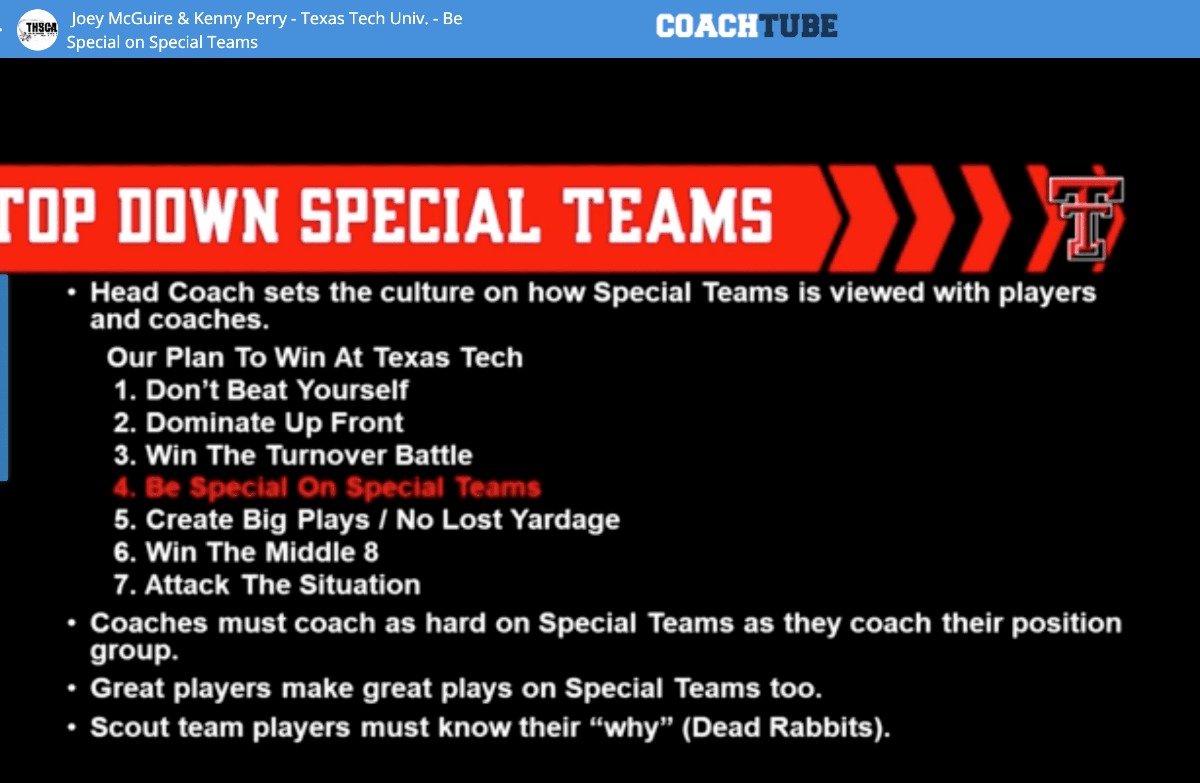
The Plan to Win Starts Top Down
Joey McGuire sets the standard. Every player in Lubbock knows the Texas Tech plan to win, and special teams is non-negotiable inside it.
Coach Perry runs through the pillars on tape:
- Don't beat yourself. No stupid penalties. No mistakes before the snap.
- Dominate up front.
- Win the turnover battle. Perry says he wants to do a better job creating turnovers on special teams specifically, so he builds turnover work directly into his special teams drills.
- Be special on special teams.
- Create big plays. No loss of yardage.
- Win the middle eight. The last four minutes of the first half and the first four minutes of the second half.
- Attack the situation.
The reason Texas Tech can play it this way is because McGuire makes it the head coach's standard, not just the coordinator's preference. Coach Perry is direct in the clip that this only works if it comes from the top.
The 15 Minutes Twice a Week Nobody Else Is Running
This is the rep most programs miss.
Coach Perry has worked it out with the Texas Tech strength staff to give him fifteen minutes on Tuesdays and Thursdays during the offseason. Every player on the roster, offensive line, defensive line, quarterbacks, all of them, runs through special teams movements.
Why? The movements are useful for every position. Hip turns, leverage, tracking, finishing. The kid who plays guard benefits from the same movement pattern as the gunner.
By the time fall camp opens, every Red Raider has been doing the special teams install for months.
Coach Perry's words on tape:
"At the end of the day, when we start football, we've already been doing these things. We've been doing them all summer and all spring."
That is a six-month head start on a unit most programs install three days before the opener. Coach Perry shows the specific drill clips he runs in those windows in the video.
Speak the Defense's Language
Tim DeRuyter sits in every one of Coach Perry's special teams meetings. He has at TCU, Kansas, SMU, and now Texas Tech. There is a reason for that.
Most of the players on Perry's special teams units are defensive players. So Perry rebuilds his terminology inside their language.
How they track the hip. How they tackle. How they block. The defensive verbiage runs the meeting.
His rule:
"I don't care what my language is. I want to speak the same language those kids understand."
The cost is the coordinator's pride. The benefit is that every kickoff cover guy hears the technique cue in the same words his position coach has been giving him all week. No translation tax on Friday.
Coach Perry talks through how he sat down with DeRuyter to rebuild the lingo in the clip.
Best Players Play. No Breathers on Kickoff.
This is the line of the talk.
Coach Perry has had assistants come to him before a critical fourth down or kickoff and ask if a starter can get a breather. Put the backup in.
His answer:
"No, you can't get a breather on kickoff. Because I need them and then some."
He is direct about the programs that run a regular kickoff team, a "12th man" kickoff, and a "winning the game" kickoff. Three different units for three situations. He doesn't operate that way. The best players go down and cover the kick. Every time. The only time it changes is if the kicker boots it out of the end zone, and then it doesn't matter.
The principle underneath: gunners who can't tackle and returners who can't catch are the kind of mistakes that cost games. Put the guys out there who can actually do the job.
Coach Perry argues the point in the clip and shows how he holds the line on it inside a staff that wants their starters fresh.
The Dead Rabbits
The scout team is the other half of the install.
Coach Perry calls his scout team players the Dead Rabbits, after the gang in Gangs of New York. Ken Plunk's son Joe is the leader of the unit.
The point of the name is identity.
A scout team that knows it's the scout team plays like the scout team. A scout team with a name, a leader, and a reputation inside the program plays like a unit. They get fired up. They compete every day. They give the look.
Coach Perry says it directly: those players are going to be the difference in how prepared his starters are on Saturday. So give them something to hang their hats on.
The teaching point underneath all of it is that special teams isn't a phase. It's a program. It runs through the strength staff, the defensive coordinator, the head coach, and the scout team. By the time Coach Perry is calling a punt return on Saturday, every piece of his install has already been touched a hundred times by everyone in the building.
Always be growing,
Coaches Clinic Community of Coaches Helping Coaches
P.S. This email is the operating system. The full Be Special on Special Teams clinic from Coach Perry is the install.
He breaks down the specific drills he runs in the 15-minute strength windows, the position-by-position movement library every player goes through, the game-planning structure he uses to install each phase, and the unit-by-unit rules for kickoff, kick return, punt, punt return, and field goal.
If you are tired of being the program that throws a special teams unit on the field with three minutes of prep at the end of practice, the full clinic is the blueprint for the way Texas Tech does it.
0 comments