Coach -
If you've stood on the sideline and watched your nickel get put in a bind on a slant for the third time in a quarter, you already know the trap. The structure looked fine on the board Thursday night. Box numbers. Leverage. Run fits. Then the ball got snapped, the quarterback read one of your defenders, and someone in your front had to be wrong.
That's the cost of being "gap sound" against a modern offense. It costs you Friday nights, it costs you your film Saturdays, and eventually it costs you the belief of the kids you're coaching. It's not a talent problem. It's a structure problem, and it has answers.
Coach Jeff Long and Coach Will Nalley both focus on defending the RPO, but they attack it from two directions. Long builds "same as" run fits that keep the post-snap picture changing for the quarterback while your players' jobs stay identical. Nalley teaches the drill work that makes a specific defensive answer in 3 Deep 2 Under coverage actually take the RPO throw window away.
Video: Jeff Long - Combating RPOs by Creating the "Same As" Run
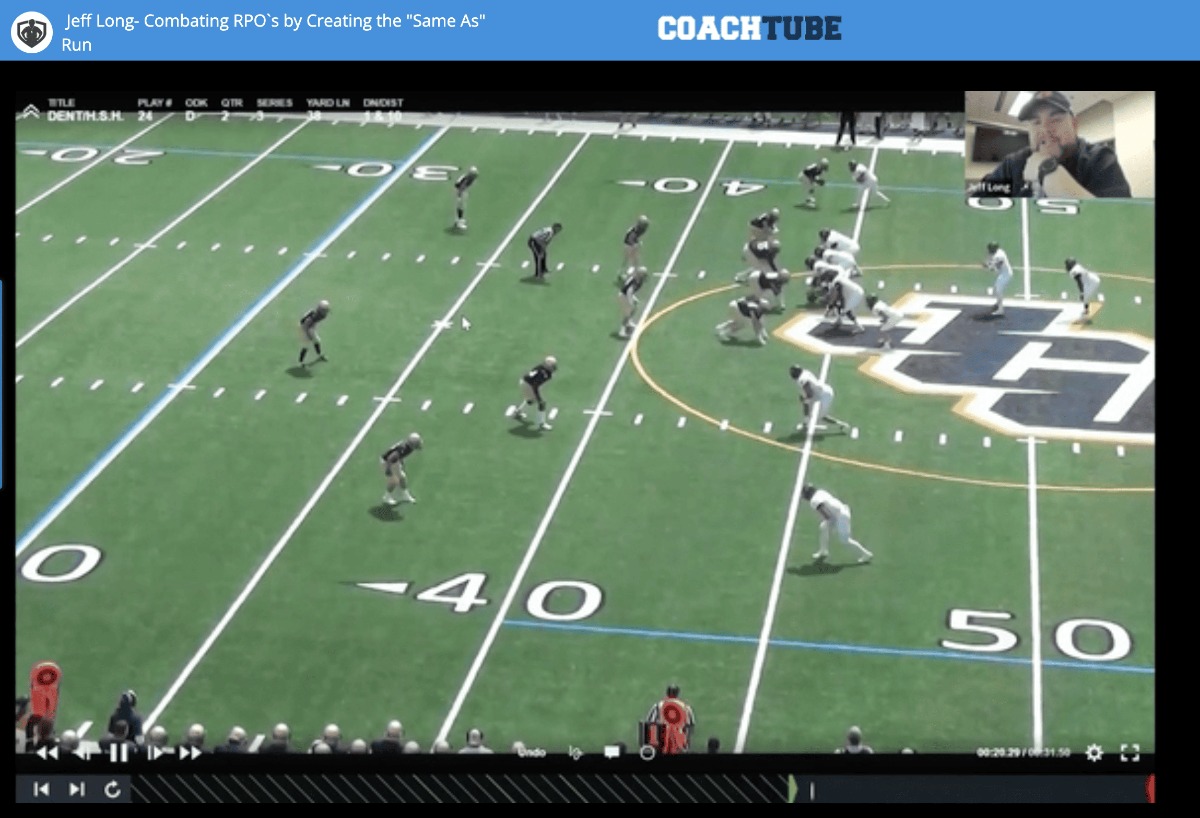
Stop Being "Gap Sound." Leverage the Ball Instead.
Coach Long is direct about the thing that gets defenses beat against RPOs, and it's the phrase a lot of coaches still say with pride: gap sound. Everybody married to a gap. Everybody has their letter and they hold it.
"If you're not like that gap conscious defense, gap sound defense...as people used to call it, where everybody was married to a gap, he'd have to hold his water and stay put. And now you're taking away opportunities for a guy to make a play."
The alternative is to leverage the ball. Players fit inside out, outside in, or top down based on the picture in front of them, and when the offense declares, defenders can cross face, chase color, and go hunt. That's how Coach Long builds a front that doesn't get stuck watching the pitch man while the quarterback keeps the ball into an empty gap.
Q+2, Hammer, Splitter, Hammer: The Fit That Stays the Same
The core of the system is a run-fit structure that doesn't change regardless of the coverage call behind it. Coach Long uses the same terms on every rotation: Q+2 in the box, a dent from the boundary outside backer, a splitter, and a hammer on each side.
The dent is the job people miss. The boundary outside backer replaces the feet of the tackle or end, forces the ball to bounce, and does it violently. In the film, Coach Long points out the dent playing nice and violent on a counter look: the will makes a decisive read, restacks, and the hammer to the boundary keeps it outside in.
The splitter is the layer that gives the front its freedom. Coach Long shows a clip where the splitter matches counter footwork instead of just firing into a gap. Because he isn't stuck to a letter, he can track back, fit inside out, and hunt the football. When the offensive line pulls, the defender doesn't have to hold his water: he can temple the ball and cross face.
The point is repetition of structure. Q+2, hammer, splitter, hammer (watch the full clip to see how coach breaks down the responsibilities with game film). Cover 3 or Poach quarters. Same four jobs no matter the call. The offense sees the same fits on tape week after week and the quarterback's read never gets to be clean.
Keep the Pre-Snap Picture. Change the Post-Snap Picture.
This is where the scheme starts to hurt quarterbacks. Coach Long shows a clip where the safety rotates down and becomes the splitter. The mic detaches and shows coverage plus body presence in the window. The hammer fits outside in. The other safety scrapes clean off the top.
Nothing about the run fit changed. Q+2, hammer, splitter, hammer. But the faces in each job changed, and the occupied windows changed with them.
"They are very rarely going to account for a safety, even though he cheats it early here. You have occupied windows. You got a mike that's detached. He's now showing...not only do I have coverage here, I have body presence."
Coach Long shows another clip where the offense thinks it has space on the backside. The defense rotates down a hair early. The window that looked clean on the pre-snap picture is a clouded window at the release point.
"He's been thinking all day. We've been dropping to cover three. He's going to have space and time. And now he doesn't. You can create bad decisions by keeping the picture the same pre-snap and then post-snap changing the picture. And you can do that when you create that same as in your run fits."
That sentence is the whole scheme in one line. Coach Long walks through more of the rotations in the clip, including what the will has to see to scrape and fit over the next blocker instead of getting caught under it.
Video: Will Nalley - 3 Deep 2 Under vs. RPO
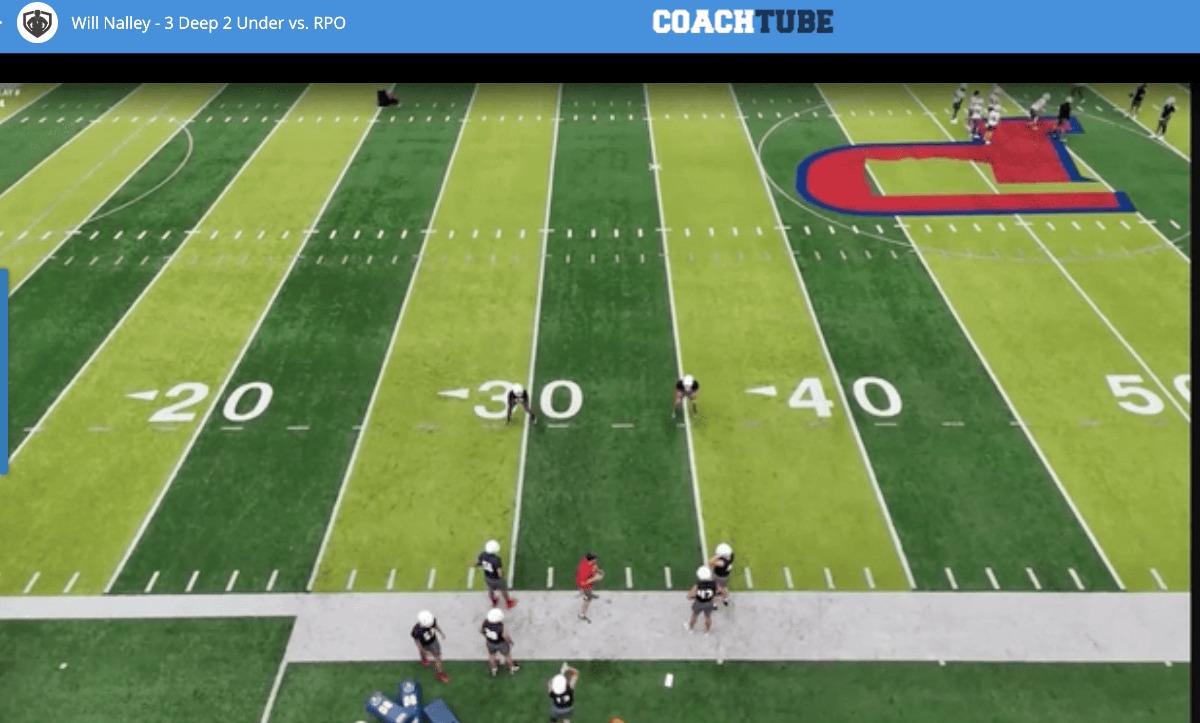
The QB Vision Drill: Eyes on the Quarterback, Break Flat, Take the Window
Coach Nalley's 3 Deep 2 Under is built on the same premise from a different direction. Instead of changing the run-fit picture, he teaches the two underneath linebackers to play the quarterback's eyes and shoulders and break directly on the throw. The drill he uses to install the break is the QB Vision Drill, and the details are what make it work.
The mechanics look simple. Linebackers are in their base stance. Coach Nalley pats the football, and that pat simulates the snap count. The linebackers take two hops back and pop their feet. From there, everything is off Coach Nalley's shoulders. He turns, they break. He pats again, they respond again.
"Your eyes should be on the quarterback. Obviously we want to try to swivel our head and take a screenshot of our passing threats. But again, your primary where your eyes are at this point in our coverage, it's on the quarterback. It is true quarterback vision coverage."
Break Flat. Not Downhill.
The single most common error Coach Nalley fixes in the clip is the downhill break. A linebacker sees movement, sees flow, reacts to the run action, and breaks his shoulders forward. The moment he does that, the RPO throw over his head is open: the slant, the glance, the hitch in the window.
"We want to encourage these guys to break flat...When I'm turning and breaking my shoulders on that, we do not encourage that. We're trying to take away that slant, that glance."
Coach Nalley is specific about what he's willing to give up and what he's not. He'll trade a short gain underneath to stay square and take away the RPO throw. Coach Nalley shows a "much better" clip of two linebackers working off the pop, turning their shoulders with his, and breaking flat at the same time the ball comes out. When the break is simultaneous with the release, the window disappears.
Progression: Start Slow, Then Make It Harder
The clip Coach Nalley uses is a July install with freshmen and young players. That's the point. The drill is meant to be a daily indy-period tool that builds on itself over months, not a one-week install.
He walks through the progression. Early on, he goes easy: clear shoulder turns, deliberate patting of the ball, simultaneous breaks. Over time, he introduces harder breaks. Then breaks followed by resets. Then sharper tempo changes. The reps build a linebacker who can keep his eyes on the quarterback, process the shoulder turn, and break flat at game speed without cheating forward.
Coach Nalley talks about combining this with safeties if your staff setup allows it, and he walks through a few more reps in the clip, including what he says to the player breaking downhill.
Long changes the picture the quarterback sees. Nalley takes away the window the quarterback throws to. Both of them start from the same premise: the way to beat the RPO is to stop putting your own players in conflict, and the way to do that is to build structure and technique that let the defender play the ball instead of the gap.
Always be growing,
Coaches Clinic Community of Coaches Helping Coaches
P.S. It's 10:47 on a Sunday night. You're in your office with the lights off, watching second-half cutups from Friday. Your mike linebacker sits on the mesh for a full count, the ball comes out clean, and the slant hits behind him for nineteen yards. You rewind it. You watch it again. You already know what the problem is. You just don't have the system yet.
The Stop the RPO Bundle is the system. Coach Long's full "Same As" Run install is in it. Coach Nalley's complete 3 Deep 2 Under is in it. More clinics from more coaches on answering the RPO out of different coverage structures are in it. One bundle price instead of buying them one at a time. Yours forever. No subscription, no renewal, no expiration.
Spring ball is about six weeks from over. After that comes summer install, then camp, then your first quarter of real football. Be the coordinator who already has the answer when the first RPO team tries to punch you in the mouth in Week 2. Grab the bundle and install it with your staff this month.
0 comments