Coach,
The Slot T is one of the most misunderstood offenses in football.
Some coaches think it's just Wing T with a different name. Others assume it's some ancient system that doesn't translate to modern football. And because not many teams run it, there's not a lot of film or clinics breaking it down, so it stays in the shadows.
Coach Shawn Liotta ran the Slot T at Burrell High School in Pennsylvania for several years. He came to it from the spread. Deep Choice, for that matter, and made the full transition to 100% under center. He studied the coaches who've run this system and put his own spin on it.
Today, we're pulling back the curtain. This is what you're actually looking at when you start diving into the Slot T, specifically, the Lead Play from the Power Series, broken down position by position.
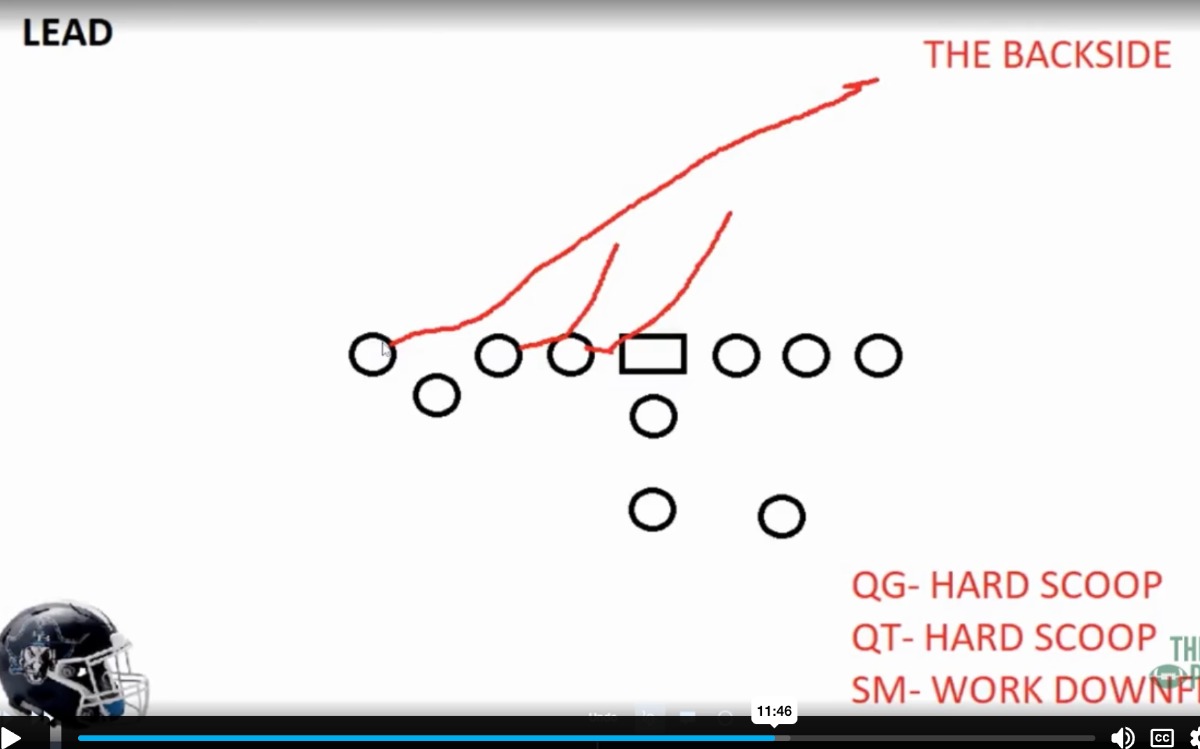 Lead Play
First, What the Slot T Actually Is
The formation dates back to the 1940s and 50s. It's a two tight end set with a fullback, halfback, and tailback, all in four-point stances. Quarterback is under center.
It has Wing T concepts. It has power football concepts. But it's its own thing.
Liotta's Power Series includes four runs that attack sideline to sideline: the Wedge, the Lead, the Power, and the Pitch. And here's what makes this series accessible for coaches who just want to test the waters: you can install it using your normal blocking progressions. You don't need to commit to four-point stances everywhere. You don't need weeks of pulling drills. The Power Series can be a short yardage package you bolt onto your existing offense.
The Lead Play is the foundation. Here's how it works.
The Blocking Philosophy: Dominate the Line of Scrimmage First
Before we get into the position-by-position rules, you need to understand Liotta's core philosophy:
"Block down linemen first. Get a push. Worry about linebackers later."
His point: too many coaches get caught up in coming off double teams early to work to linebackers. The result? You don't get great movement at the point of attack.
Liotta wants his linemen creating a new line of scrimmage. If the linebacker makes a play four yards downfield, so be it. But that defensive lineman isn't going to be the one making the stop.
With that philosophy in mind, here are the rules.
Front Side Blocking Rules (Lead Play to the Right)
Strong End (Tight End): Base out. His job is to press the inside number of the defender, get movement, and get that defender's butt into the hole. He cannot allow C-gap penetration. This is a longer block and he has to maintain contact and cover the man up.
But what if there's a 5-technique or the defender is slanting hard inside?
That triggers the Dino Call.
The Dino Call: When there's a C-gap defender (like a 5-technique), the tight end calls "Dino, Dino, Dino" to the strong tackle. Now those two double-team the 5-technique together.
The Dino call also changes the halfback's assignment. He takes a J-step and kicks out the defensive end instead of leading through the hole. The leverage of a walked-up end allows your halfback to execute this block with placement rather than brute force.
Liotta doesn't teach traditional line techniques. His players learn gaps: A-gap player, B-gap player, C-gap player, D-gap player. On Lead, a C-gap player means Dino. Simple.
Strong Tackle: Man on, to inside unless he gets the Dino call, which takes him to the double with the tight end.
Strong Guard: Scoop the playside gap to a potential double team with the strong tackle. The strong tackle will likely have a double somewhere—either with the tight end (Dino) or with the guard on a B-gap player. Cancel the B-gap. No penetration.
Center: Same rule, scoop playside. Cancel the A-gap. No penetration.
Here's how the doubles develop naturally: if there's a Dino call on the C-gap player, there's probably no B-gap defender. So the guard works down into a double with the center on the shade or A-gap player. The doubles trigger off the Dino call.
Back Side Blocking Rules (The Cut Block System)
This is where it gets fun for your kids.
Liotta operated under NFHS rules in Pennsylvania: cut blocks only at the line of scrimmage, immediately at the snap. No high-low. No downfield cuts. No cuts outside the box.
His linemen love to cut. But they primarily use it for two purposes:
1. Protecting pullers (on other plays in the system)
2. Back side of the Lead Play
Quick Guard and Quick Tackle: Hard scoop rule. If there's a defender in that inside gap—especially a stud who wants to flat-down the line and blow up the play—cut him.
Liotta's reasoning: you can't afford to let a war daddy cross the guard's face and make a play in the hole. A cut block slows him down.
They work cut blocks against bags every single day. Shot blocks, shot-and-drive, double teams, down blocks, scoop blocks, and cut blocks—six blocks, repped daily in individuals.
And here's the mental warfare piece: Liotta says he sits through pregame referee meetings where opposing coaches have already complained about the cut blocks. They're worried about getting hurt. It slows down defensive linemen who want to be Aaron Donald. It's in their heads before the game starts.
Swing Man (Backside Tight End): Hard scoop inside, then work across the field. He might spring the run for a touchdown by getting to the safety.
The Skill Position Assignments
Tailback (the slot): Goes in Tom motion, running through the feet of the fullback at about 5 yards, coming flat down the line into the pitch track. He's selling the pitch fake. This motion pulls defenders out of the box. (The Pitch Play off this action is a designed play, not an option, but a basketball chest pass from the QB.)
Halfback: Without a Dino call, he leads through the hole and ISOs the most dangerous linebacker inside the tight end. First guy inside the tight end—that's his man.
With a Dino call, he J-steps (inside foot first) and kicks out the defensive end. The J-step flattens his track so he can attack the end's inside number.
Liotta's halfback was his leading rusher this year—about 1,500 yards. Kicking out defensive ends isn't his specialty. But it's a placement block, not a kill shot. Cover the man up. Let the fullback work his track.
Fullback: Aiming point is the outside hip of the guard. If he hears Dino, he veers wider because the double is on the C-gap player and the halfback is kicking out the end. The end often runs upfield, making the kick-out easier.
Quarterback: Opens playside at 5 o'clock (clock system), gets the ball as deep as possible to the fullback, rides him into the hole, then carries out the wide fake. That fake matters as the tailback in motion pulls defenders out of the box.
Liotta spends at least 10 minutes daily on a mesh drill working backfield tracks and fakes.
This Is What's Inside the Slot T
That's one play. The Lead Play. And you just saw:
- A gap-based blocking system (no traditional line techniques—just A, B, C, D gap identification)
- The Dino call that adjusts your scheme on the fly based on how defenses deploy their C-gap player
- A philosophy of getting movement at the line before worrying about linebackers
- Backside cut blocks that slow pursuit and get in defenders' heads before the game even starts
- Motion and faking that pull defenders out of the box
This is the level of detail that exists throughout the Slot T. The Wedge, the Power, the Pitch: each play has its own rules, its own adjustments, its own answers to what defenses give you.
It's not Wing T. It's not some relic. It's a system that lets you control the game, shorten it, and win with physicality, whether you run it full-time or bolt it on as a short yardage package.
Coach Liotta breaks down the full Power Series, plus the play-action shots that come off of it, in the complete clinic.
[LINK: Watch the Full Slot T Clinic Series]
Always be growing,
Coaches Clinic Community of Coaches Helping Coaches
0 comments