Coach -
Spring practice is where you set the daily habits that carry into fall. And the first habit most QB groups get wrong is how they start throwing.
They grab a football and start chucking it. No arm prep. No muscle activation. Just reps on a cold arm. By the time they're loose, they've already thrown 15 balls with bad mechanics because the muscles weren't ready to fire correctly.
One way Coach Steve Cooley fixes that with a 90-second heavy ball warm-up he runs before his quarterbacks touch a regular football. Four movements. Both arms. One ball for every two guys. The whole thing takes less time than your team stretches, and it gets the wrist, triceps, and shoulder ready to throw before a single pass.
His philosophy is simple: "Warm up to throw. Don't throw to warm up."
Video: Steve Cooley on the Heavy Ball QB Warm-Up
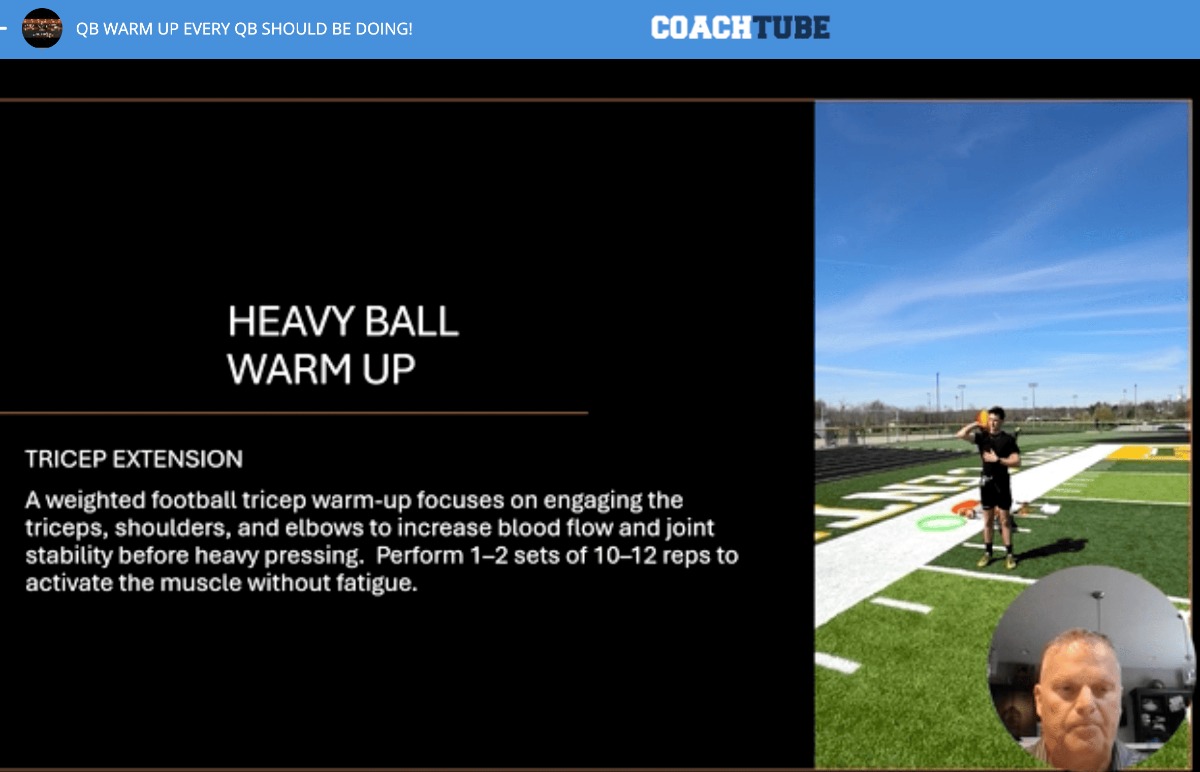
Tricep Extensions
The warm-up starts here. The quarterback holds the heavy ball and works straight tricep extensions. All the way down, full extension back up, 10 reps. Then toss it to your partner.
Coach Cooley does both arms. Not just the throwing arm. Both.
"So you don't have one ginormous tricep on your throwing arm and then a little bitty tricep on your other arm."
It sounds minor, but balanced arm strength matters for quarterbacks who are absorbing hits, extending plays, and stiff-arming in the run game. Spring is the time to build that symmetry into the routine before it becomes an afterthought.
Small Circles
This is where the detail starts to matter.
The quarterback holds the heavy ball out with his wrist cocked and loaded at a low 90. Coach Cooley's cue: imagine the point of the football is a pencil. Now draw small circles with it. Ten one direction, ten the other direction. Then flick it to your partner. Do it twice through.
The emphasis is on the wrist position. The ball doesn't float out loosely. The wrist stays cocked the entire time, which targets the small stabilizer muscles around the wrist and forearm. Those are the muscles that control the snap at the end of the throw. They're also the muscles that fatigue fastest in young quarterbacks who haven't built them up yet.
If your spring practice is 15 days, that's 15 sessions to build those small muscles before summer, and it starts with getting them warm and activated every single day.
Big Circles
Same concept, bigger canvas. Coach Cooley tells his quarterbacks to imagine they're painting a circle as big as possible with the point of the football.
The coaching points stay the same: keep the ball cocked, keep the point up, trace the circle at nose level. The difference is the range of motion. The big circles put real strain on the shoulder because the heavy ball is moving through a much larger arc. Coach Cooley acknowledges it. "It is heavy, and it does put a little bit of strain on your shoulder, but it is a good warm up and they will get stronger with that as well."
That's the point. You're not just warming up. You're building the muscles that matter for throwing a football while you warm up. Coach Cooley walks through the full technique and what to watch for in the clip above.
Dart Throws
The final piece, and the one that most directly mimics the throwing motion.
The quarterback throws the heavy ball to his partner like a dart. The focus is on three things: rotation, extension, and wrist snap. Coach Cooley varies the foot position daily. Some days it's feet parallel. Some days it's throwing foot forward. Some days it's the non-throwing foot forward. Each variation isolates the upper body mechanics slightly differently.
The most common mistake Coach Cooley sees, especially with younger players: they shot put it. "We don't want to shot put it." The ball is two to three pounds, and kids who aren't strong enough yet will push it instead of flicking it. That's the coaching cue. Flick and extend. Snap the wrist through. If the ball spirals, the wrist is doing its job. If it wobbles, they're muscling it.
And here's the overload training principle at work. Once the warm-up is done and the quarterbacks switch to a regular football, they can feel the difference immediately. The regular ball feels light. The snap feels faster. The muscles that were just loaded with extra weight are now firing on a ball that weighs a fraction of what they just threw. Coach Cooley uses that contrast deliberately. He goes into more detail on the feel and the progression in the video.
Ninety seconds. That's what this costs you. One ball for every two quarterbacks, four movements, and your guys are warm before they throw their first real pass of the day. If you're building your spring practice schedule right now, this is the kind of drill that takes almost no time, requires almost no equipment, and pays off every single day it gets repped. The arm prep becomes automatic. The muscles develop over the course of the spring. And your quarterbacks never start a session throwing cold again.
Always be growing,
Coaches Clinic Community of Coaches Helping Coaches
P.S. Coach Cooley's full clinic, The QB Warm-Up Every QB Should Be Doing, covers more than the heavy ball work.
He walks through his complete warm-up progression for quarterbacks, including the movements and sequences that lead into live throwing. If you're installing a daily QB routine for spring practice, the full course is below:
Link: Steve Cooley - The QB Warm-Up Every QB Should Be Doing
0 comments