Coach -
Most RPO problems aren't scheme problems. They're quarterback problems.
The read is right. The concept is sound. But the quarterback can't get his hips around fast enough, or he hitches when he should be throwing, or he's a half-second late flipping to a new target because his feet weren't ready.
Brent Dearmon has coached quarterbacks at every level, from 13-year-olds he trained on the side to Mike DeLillo, who went on to play in the UFL. He was a four-year starting quarterback at Bethel University, wrote *The Evolution of the RPO*, and has built his career around one idea: keep things simple so your quarterback can play fast. In this clip, he shares the three drills he uses to train quarterbacks specifically for RPO execution.
Video: Brent Dearmon - RPO QB Drills
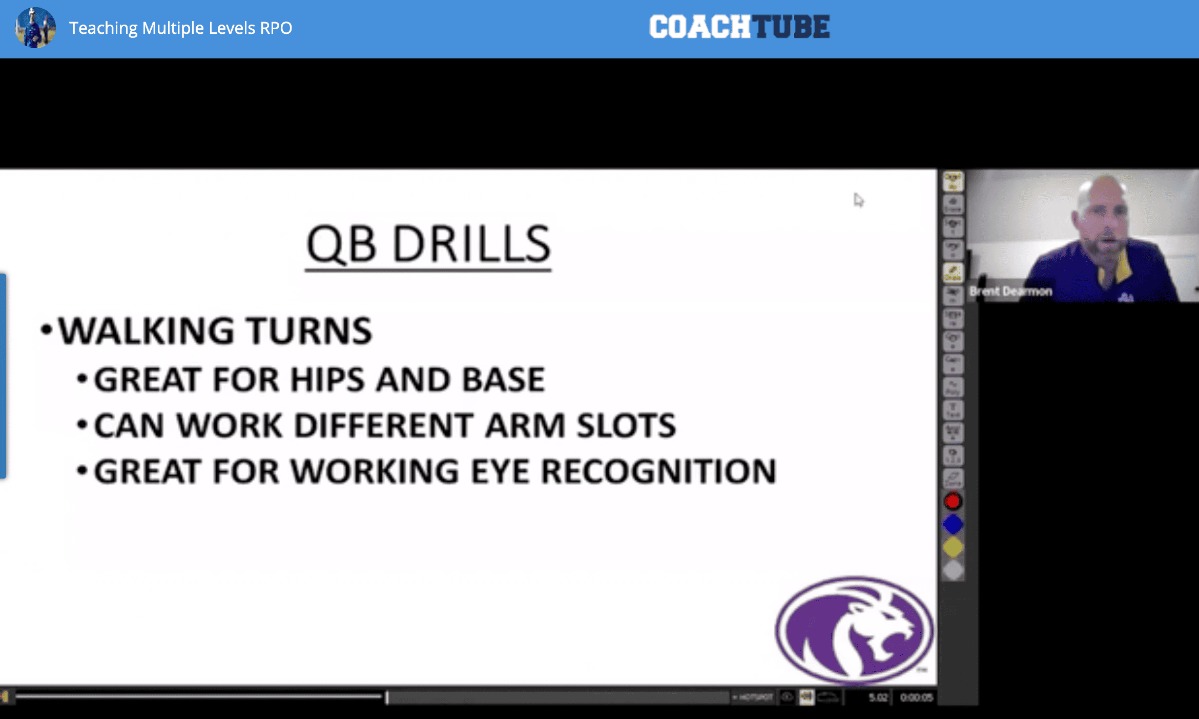
Drill 1: The Walking Turn
This is a hip rotation drill, but Dearmon uses it for more than just mechanics. It trains arm slot variety and eye speed at the same time.
The setup is simple. The quarterback takes three steps: right, left, right (for a right-handed QB). On that third step, he sticks his foot in the ground and builds what Dearmon calls a new mound. Think of it like a pitcher in baseball creating a surface to push off of.
From there, the quarterback brings his back hip through the zone. That's the whole drill. Stick the foot, build the mound, rotate the hip.
The reason this matters for RPOs: the quarterback has to turn and deliver to different targets at different angles, often with zero time to reset. If his hips are slow or his lower half isn't generating power through the turn, the throw is late. The walking turn trains the rotation pattern so it becomes automatic.
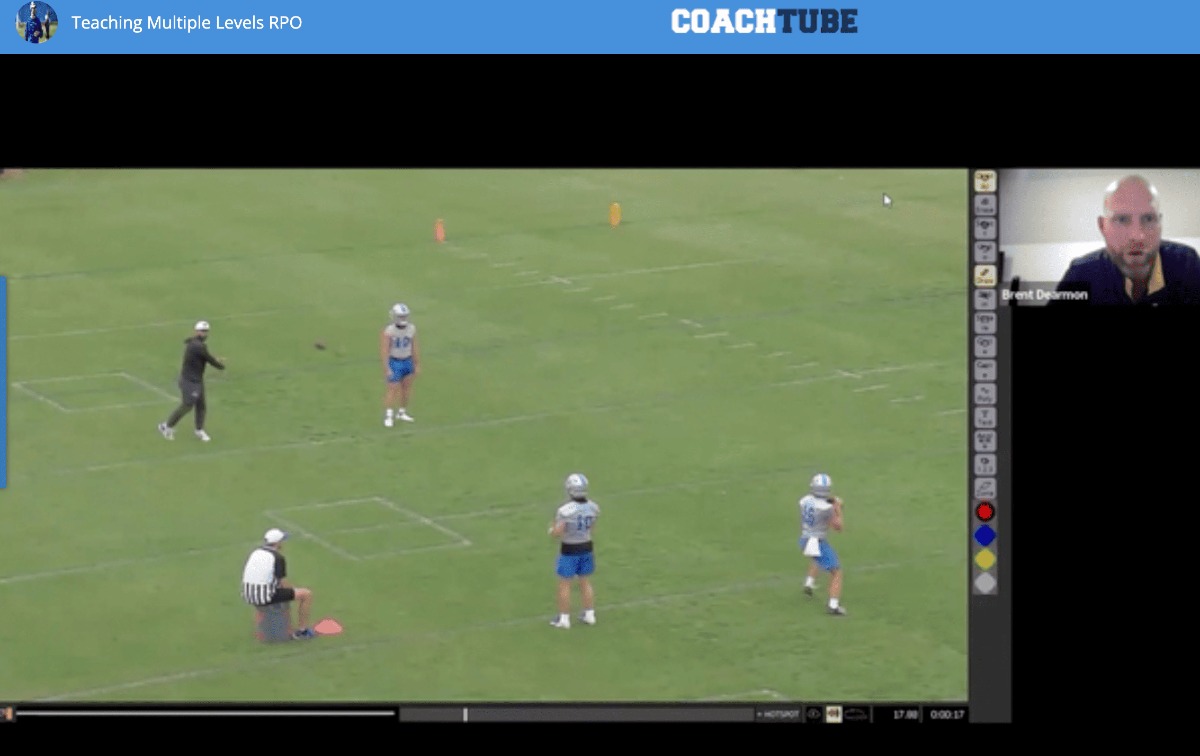
Dearmon also uses this drill to work different arm slots. The quarterback isn't always throwing from the same platform in RPO situations. Sometimes the release point changes based on the angle of the throw. This drill gives him reps at those different slots while grooving the hip rotation underneath.
Drill 2: The Knee Drive
Dearmon stole this one from his dad, who was an offensive line coach. His dad used to start guards on a knee and have them drive up into L pulls. One day Dearmon was looking for a way to teach quarterbacks to transition their weight better and adapted the concept.
Here's how it works. The quarterback starts with his non-dominant foot (left foot for a right-hander) flat on the ground, other knee down. He drives up off the ball of that flat foot and sticks his opposite foot directly underneath him. Not out wide. Not reaching for width. Straight underneath.
As soon as that foot hits the ground, he's loading and throwing.
The drill solves a specific problem Dearmon sees constantly, especially in younger quarterbacks: the big step. That oversized hitch step at the end of a drop, or the wide last step that kills timing. Quarterbacks who don't understand their base take that big step because they're trying to generate power with distance instead of with their base.
The knee drive teaches them to push through the hip and throw from a tight, stable platform. Dearmon says it's one of the best drills he's found for teaching a quarterback how to play with a base and drive off of it.
For RPOs specifically, this is the last step of the drop and the moment of decision. If the quarterback is taking a big, wide step before he delivers, the window closes. The knee drive trains him to put that foot in the ground underneath him, load, and let it go.
Drill 3: The Angle Flip
This is the most RPO-specific of the three, and it's purely reactionary.
Dearmon points a direction. The quarterbacks slide that way, cutting grass with their feet. At some point, Dearmon gives a ball call (a clap, a whistle, whatever the reaction cue is for that day). The quarterback immediately flips his hips toward the target and makes the throw.
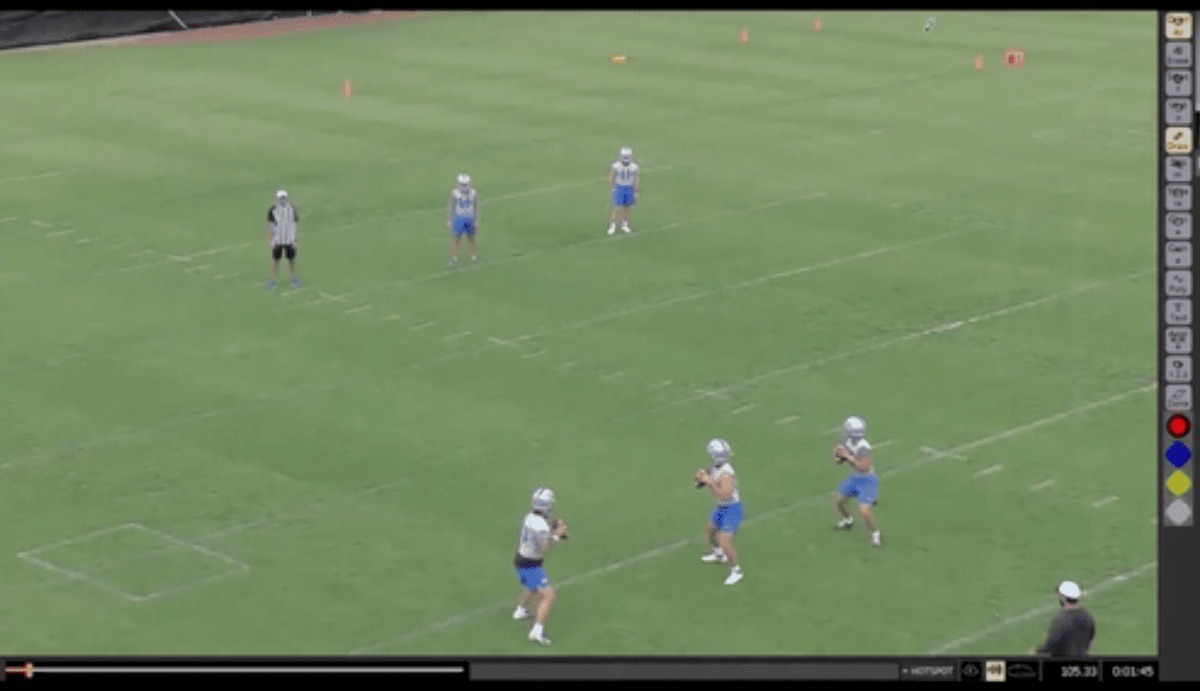
The next rep, Dearmon changes the angle. Now they're sliding a different direction before the call comes.
The key detail: Dearmon always gets in a position where the quarterbacks can't see him. It's not a visual cue they can anticipate. It's a true reaction. They have to process the signal, flip their hips, find the target, and deliver. All at once.
This simulates what happens in a live RPO. The quarterback is riding the mesh or sliding through his footwork, reading a defender, and when the defender triggers, the quarterback has to redirect and throw immediately. There's no time to gather himself. The angle flip trains that exact moment.
Dearmon runs this drill during special teams periods when he can grab a few extra guys. It doesn't need a full offense. Just a direction, a reaction cue, and a target. He walks through several variations in the clip above.
Three drills, one principle: train the quarterback's body to do what the RPO demands before you ever ask him to read a defender.
The walking turn builds hip rotation and arm slot flexibility. The knee drive teaches weight transfer and a compact base. The angle flip trains the reactionary throw that RPOs require when the read triggers.
Dearmon's whole philosophy is keeping it simple enough that the quarterback can play fast. These drills are part of how he gets there.
Always be growing,
Coaches Clinic Community of Coaches Helping Coaches
P.S. Coach Dearmon and 6 of the top offensive minds just release are included in the RPO Evolution. Learn More Here --->
0 comments