Coach -
If your offensive linemen are thinking at the snap, they're late. And if they're late, they're losing.
Most blocking schemes ask players to identify specific defenders, process calls, and adjust based on what the defense shows. That's a lot of decision-making for a kid who needs to fire off the ball. The more your scheme asks a player to think, the longer it takes him to move. The Wing-T was built to solve that problem.
Coach David Weathersby, an experienced offensive coach known for his disciplined, fundamentals-first approach to building programs, breaks down the rules-based blocking system that drives the entire Wing-T offense. Six words. Same rules for every player. Every play.
Video: Rules-Based Blocking in the Wing-T
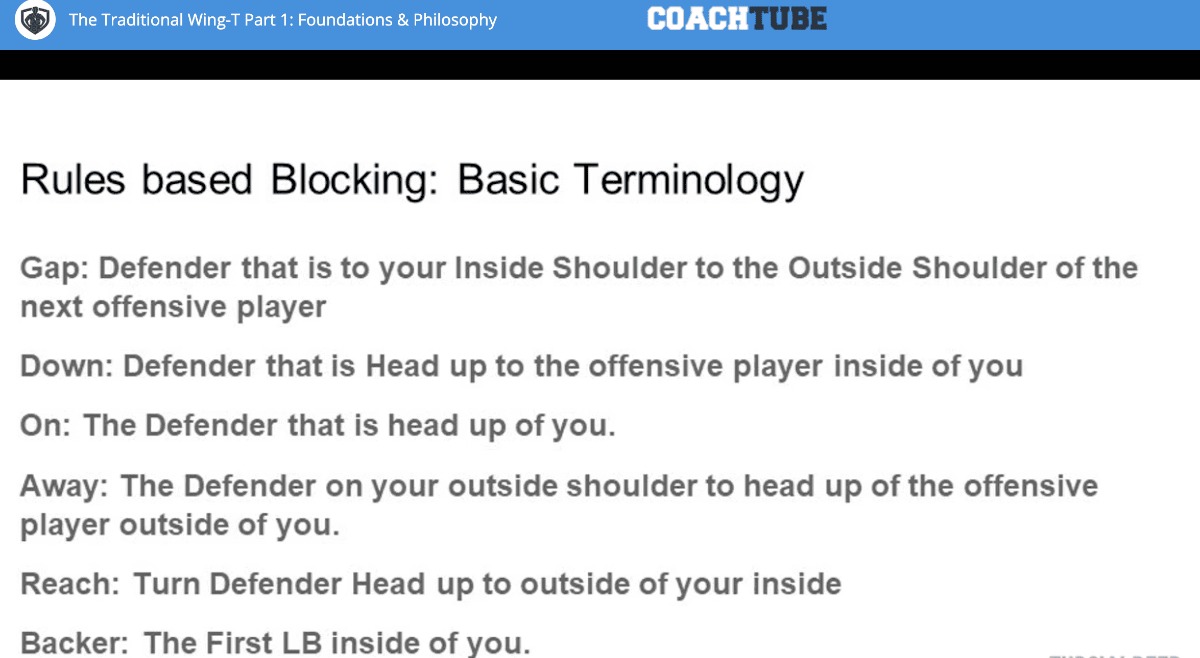
Six Words, One System
The Wing-T's blocking vocabulary is built on six terms: gap, down, on, away, reach, and backer.
Each one tells a player where to look and who to block based on their position relative to the defense:
- Gap: The defender inside your inside shoulder to the outside shoulder of the next offensive player inside you.
- Down: The defender head up on the offensive player inside you.
- On: The defender head up on you to the defender on your outside shoulder, to head up on the offensive player outside you.
- Away: The defender on your outside shoulder away from the ball. An away call usually means you're down blocking or kicking out the man outside of you.
- Reach: The defender head up or outside you. You're working to get your inside shoulder to his outside shoulder and turning him inside. This comes when the ball is going outside.
- Backer: The first linebacker inside you on your track.
That's the entire vocabulary. It doesn't change from play to play. It doesn't change from position to position. Coach Weathersby is direct about this: whether you're an offensive lineman or one of the ball carriers, the rules are the same. The Wing-T is rules-based blocking all the way through.
How the Rules Apply to Plays
The terminology becomes a decision tree when you attach it to a play call.
Coach Weathersby diagrams this against a 3-4 defense, which he notes tends to present as a 5-5-3 against his Wing-T formations. He walks through two plays to show how the rules work in practice.
On Buck, the right tackle's rule is gap-down-backer. The tackle looks gap first: is there a defender between him and the guard? If yes, that's the block. If not, he goes to down: is there a defender head up on the guard? If yes, block him. If nobody's there either, the tackle works to backer and takes the first inside linebacker on his track. Three reads, one track. He goes through them in order until he finds his man.
On Belly, a left tackle might have a rule of gap-on-away. Same decision tree. Look gap first. Nobody there. Look on: is there a defender head up on me? In one look, there is, and that's the block. In another look, nobody's on, so the tackle goes to away and kicks out the defender outside him toward the sideline.
When the play goes outside and the call is reach, the assignment changes direction. Now the tackle is working to get his inside shoulder to the outside shoulder of the defender and turning him in. Because the ball is going outside, the block seals the edge.
Coach Weathersby walks through each scenario in detail in the clip, including the specific tracks and how each read triggers the next one.
The Step Most Coaches Skip
Here's something Coach Weathersby addresses that a lot of coaches blow past.
Before you install a single blocking rule, your players need to understand what inside and outside mean. Inside is anything toward the ball. Outside is anything toward the sideline. Coach Weathersby has been coaching long enough to know that if you assume your kids already have this down, you're building on a bad foundation. He says it directly: high school kids should know this. They don't.
That's a Wing-T principle showing itself. The system doesn't assume your players come in understanding concepts. It builds from the ground up. You teach inside and outside. Then you teach the six terms. Then you attach those terms to plays. And because the vocabulary never changes, the install compounds. Every new play reinforces the same rules your players already know instead of asking them to learn a new set of assignments.
That compounding effect is the argument for the Wing-T.
Every offense has to block. Every offense has to teach kids where to go and who to hit. The question is whether your system makes that easier or harder every time you add a play. Most schemes add complexity. The Wing-T doesn't. One vocabulary handles every play in the playbook and applies to every position on the field. Your players get faster, not slower, the more you install. The gap-down-backer read that works on buck is the same decision tree that shows up everywhere else in the system.
You can have the most creative backfield action in your conference. None of it matters if your five up front are processing instead of firing. Rules-based blocking gives them a system simple enough to execute without hesitation and versatile enough to handle whatever front lines up across from them.
Always be growing,
Coaches Clinic Community of Coaches Helping Coaches
P.S. This clip is one piece of Coach Weathersby's full course, The Traditional Wing-T Part 1: Foundations & Philosophy.
The complete clinic covers the offensive philosophy behind the Wing-T, the responsibilities of every position in the backfield and on the line, how formations create leverage and misdirection, player splits and alignments, the series-based structure that ties plays together, and the play-calling system that organizes the entire offense.
If you've been considering the Wing-T or want to understand the system from the ground up, this is the starting point.
Link: David Weathersby - The Traditional Wing-T Part 1: Foundations & Philosophy
0 comments