Coach -
Most quarterback coaches jump straight to mechanics. Grip, base, release point. But if you haven't made the right decisions before your first drill, the mechanics work doesn't matter.
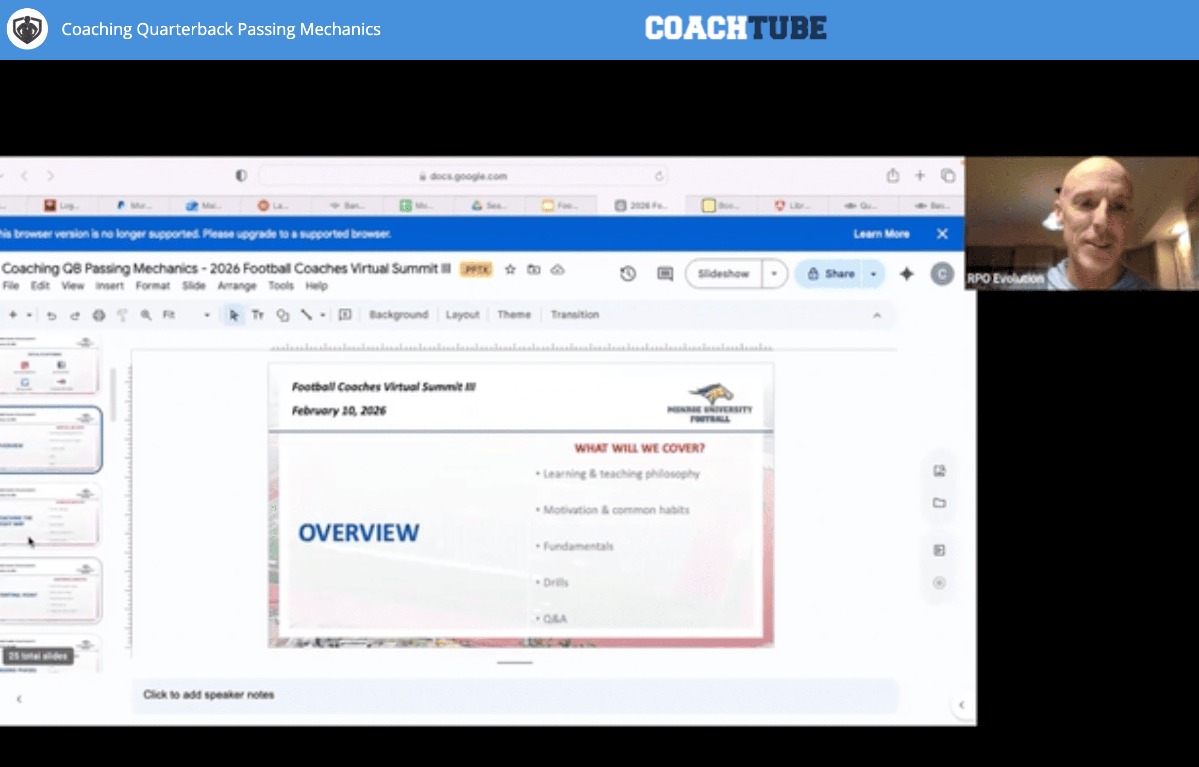
Chris Johnston, Quarterbacks Coach and Recruiting Coordinator at Monroe University, coaches this position every day. In this clip, he lays out the foundation that comes before any mechanical instruction: how to pick the right quarterback, how to avoid coaching damage, and how to structure your teaching so the quarterback can actually retain and apply it.
Video: Chris Johnston on Teaching Quarterback Passing Mechanics
Pick the Right Guy
Coach Johnston starts here because everything downstream depends on it. You need a quarterback who has natural leadership, physical capability, communication skills, and football IQ.
That sounds obvious, but the real point is about fit. If you have options, pick the guy who fits what you do. If you don't have options, and it's a guy forced on you by circumstance, then you make the offense fit him. Either way, the fit has to exist. Coach Johnston goes deeper into the characteristics that matter in the clip above.
Do No Harm
This is the one Coach Johnston says he learned the hard way.
Early in his career, he found himself looking for problems that weren't there. He had a picture of what the prototypical quarterback throw looked like, and he'd try to correct guys toward that model. The problem: some of those guys were pain-free, effective, confident, and playing fast. He was creating issues where there weren't any.
"There was probably a couple times I should have just left the guy alone and didn't try to make corrections that didn't need to be made."
The principle is simple. If the quarterback is healthy, accurate, and playing with confidence, don't touch it. Not every quarterback needs to look the same. Coach Johnston calls it a doctor's oath: do no harm first. Then evaluate what actually needs work.
Teach in a Progression
Coach Johnston says this one deserves a double underline, and he's right.
When you teach mechanics in a defined progression, two things happen. First, the quarterback can self-diagnose. If he's having trouble with his delivery, he can trace it back through the progression. "Hey, I'm having issues early on in my delivery. I remember coach talked about our base, the way we contact the ground." That kind of association only happens when the teaching has a clear sequence.
Second, it creates a shared language. Coach to quarterback and coach to coach. Everyone is using the same terms and the same framework. When a problem comes up on film or in practice, the conversation is efficient because both sides know exactly what phase of the throw they're talking about.
Know What You've Got
Before you start coaching mechanics, Coach Johnston says you need a decisive answer to one question: what type of quarterback do I have?
He breaks it into three categories:
- Pure pocket passer: This guy is not going to take off and create in the pass game when things break down. You know that going in.
- Hybrid: The converted receiver, the athlete who can throw. Coach Johnston says this is especially common at the high school level. He can run the ball effectively and hopefully throw it effectively too.
- Emergency: He's an athlete, but you don't know what his passing capabilities are. You know you don't want to ask him to do too much as a thrower.
The point isn't labeling the quarterback for the sake of it. The point is that the label determines what you teach, how much you teach, and how you call the game around him.
Design and Call Your Game Around the Quarterback
Coach Johnston splits this into two scenarios depending on your role on staff.
If you're the quarterback coach and the play caller: Make sure the offense you design and the sequence you call plays in fits the guy you've got. Don't ask an emergency athlete to execute a full-field progression concept. Don't limit a pure pocket passer to a run-heavy scheme because it's what you ran last year.
If you're the quarterback coach but not the play caller: Coach Johnston says this is where alignment with the offensive coordinator becomes critical. The things you teach your quarterback have to translate to the offense the coordinator is calling. If you're drilling your guy on one thing and the OC is calling concepts that require something different, you've got a disconnect that shows up on game day.
Film Now, Not Later
Coach Johnston's method for measuring results is straightforward: get your quarterback on film. Grab the iPad, the iPhone, a camera. Whatever you've got.
The key detail: do it now. Don't wait until preseason. Don't wait until game reps. Film your quarterback throwing right now, wherever you are in the calendar. It's the best evaluation tool you have, and if you're not using it at this stage, you're missing an opportunity to teach.
Keep It Bite-Sized
One more point Coach Johnston makes early in the clip that's worth pulling out: today's quarterbacks don't learn from long, drawn-out explanations. In a digital age, the guys sitting in your meeting room are wired for short bursts of information.
Coach Johnston's approach is to keep messages succinct and deliver content in bite-sized portions the quarterback can actually apply. That's not dumbing it down. It's coaching the way the player learns. If you're delivering 20-minute lectures on arm mechanics and wondering why your quarterback's eyes glaze over, this is the adjustment.
The mechanics matter. But the decisions you make before you ever talk about a grip or a base or a release point determine whether the mechanical work sticks. Pick the right guy. Don't fix what isn't broken. Teach in a clear progression. Know what type of thrower you have. And build your offense around that answer.
Always be growing,
Coaches Clinic Community of Coaches Helping Coaches
P.S. This clip covers Coach Johnston's teaching philosophy and pre-mechanics framework, but the full clinic goes much further.
He breaks down every phase of the quarterback's passing motion with specific technique cues, walks through the drills he uses to train each phase, and shows course footage of those drills in action.
If you're looking for a complete system for teaching quarterback passing mechanics from the ground up, check out the full clinic below:
Link: Chris Johnston - Coaching Quarterback Passing Mechanics
0 comments