Coach -
Tempo has become one of the most misunderstood concepts in offensive football. Everybody wants to "play fast," but the staffs getting the most out of tempo aren't just racing to the line and snapping the ball. They're manipulating pace to create problems the defense can't solve through alignment alone.
This week, we're looking at three different approaches to tempo from coaches who have refined their systems through years of trial and error.
Jason Mohns: The Three-Speed Approach
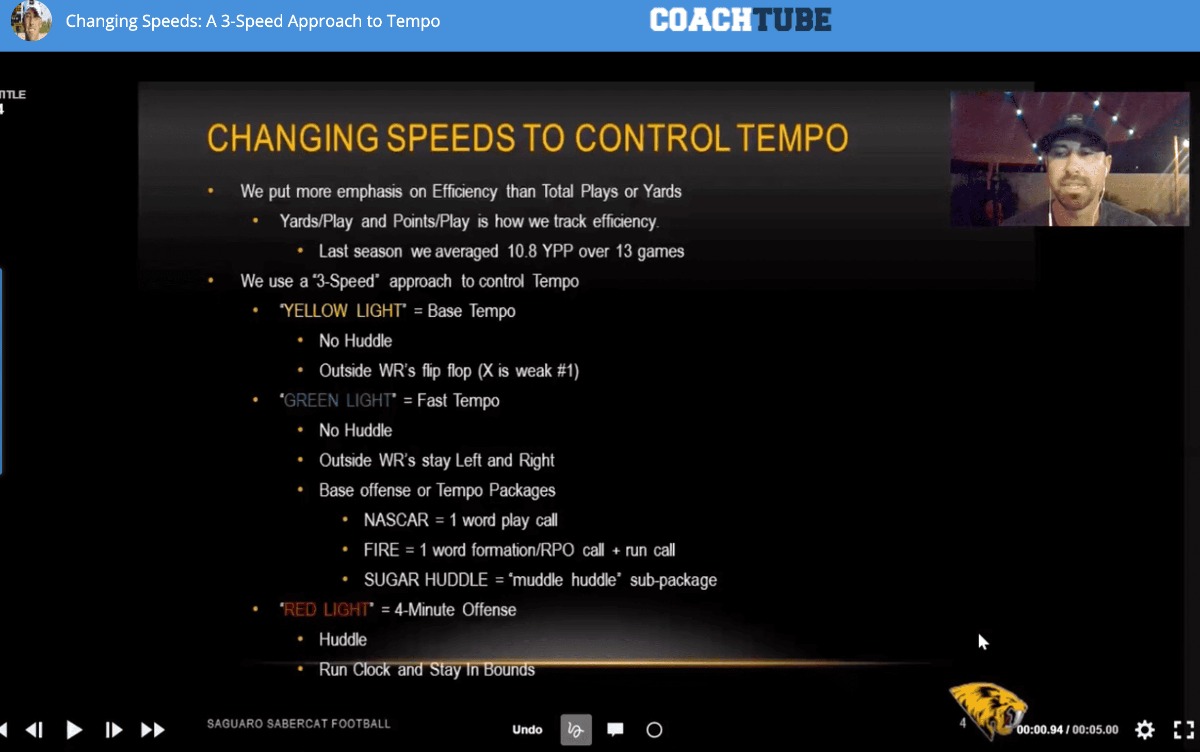
Jason Mohns runs what he calls a "three-speed" tempo system: yellow light, green light, and red light. The distinction matters because it forces you to think about tempo as a tool rather than a default setting.
His base tempo is yellow light. Still no-huddle, but controlled. The key here is that Mohns flip-flops his outside receivers. His Z is always the strong number one. His X is always the weak number one.
The reason: Mohns wants to isolate his best receiver away from trips. When he goes three to the field, his X is by himself on the backside. That puts the defense in a bind. Either they match him one-on-one, or they bracket him and give up numbers somewhere else.
Yellow light gives him time to get those receivers in position. He's not trying to snap fast. He's trying to snap right.
Green light is where things speed up. Outside receivers stay left and right. No flip-flopping. From there, he can run base offense faster, or he can get into his NASCAR package, which is an eight-to-ten play menu with one-word calls.
He also runs a fire package he picked up from Tim Beck at Texas. It's a one-word formation and RPO call that lets him tag whatever run he wants. And he uses a sugar huddle package, which is the Auburn muddle huddle concept Kenny Dillingham ran before going to Florida State. It's not about snapping fast after the spot. It's about creating confusion through personnel grouping and alignment.
The takeaway: Mohns averaged 10.8 yards per play last season over 13 games, including two top-25 opponents and 10 playoff games. He tracks yards per play and points per play, not total snaps. Efficiency over volume.
Bobby Acosta: Building a One-Word System
Video: Introduction to One Wording Your Offense
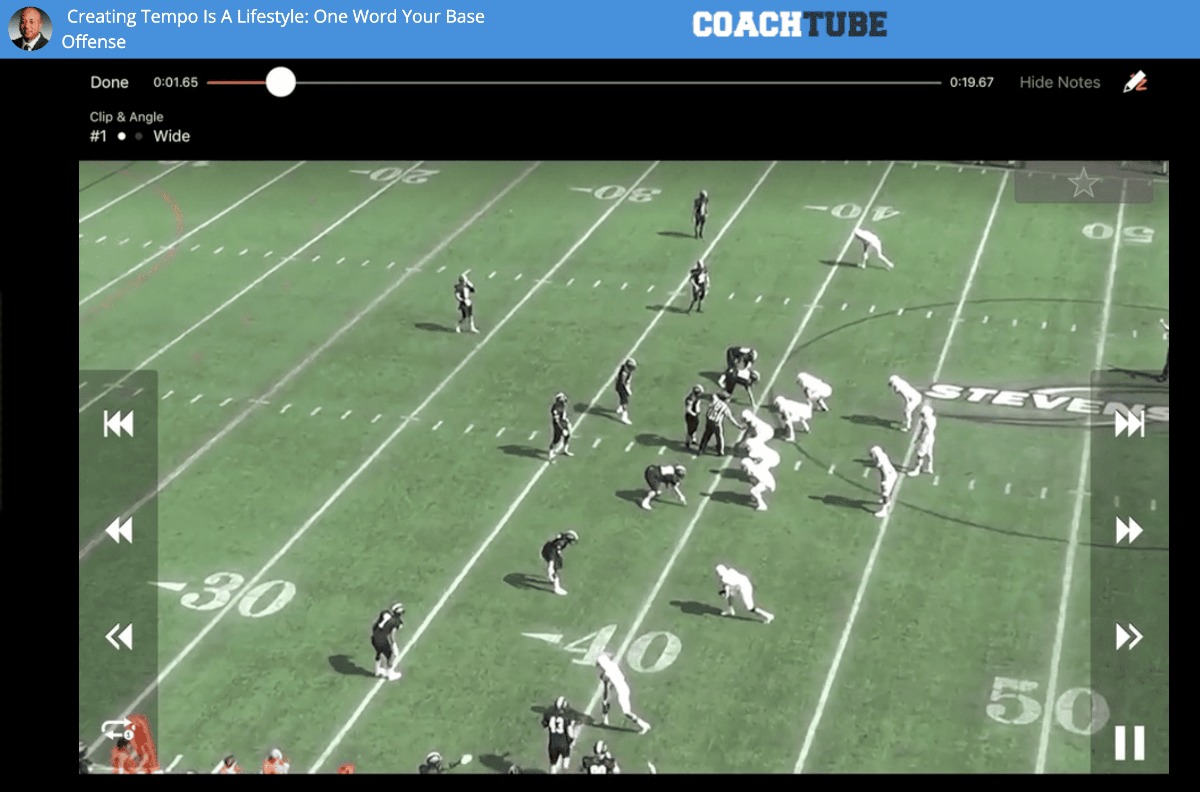
Bobby Acosta approaches tempo from a different angle. For him, it's about how many plays you can compress into a single word.
His base offense is 26 plays. After summer install, he looks at what his guys execute best and finds ways to one-word six to twelve of them. The formation, protection, and concept are all baked into that one word.
His players come up with the signals. That gives them ownership and speeds up recognition. Once they've got the base one-word system down, he layers in motions and RPO tags without adding new verbiage.
The clips from Acosta show what this looks like in practice. A nub tight end set with inside zone split zone. One word. The defense is flipping assignments, players are on the ground, and the running back is through the smoke before they sort it out. A trips into the boundary concept with protection and route concept built in. One word. Easy completion.
The common thread across all the offenses he's led: defenses can't practice that tempo during the week. Your opponent doesn't have the reps to simulate it.
The real value of one-wording isn't just speed. It's that your players are playing instinctively.
Jeff Steinberg: The Operations Side of Tempo
Jeff Steinberg makes a point that gets overlooked in tempo conversations: defensive coordinators have caught up. They don't need to huddle. They've drilled their checks. If you're just playing fast, you're giving them reps to get comfortable.
That's why Steinberg focuses on the operational details that actually let you control pace. His target is ball snapped within 12 to 15 seconds of the spot.
That starts with teaching players who to give the ball to after a play. Receivers who catch the ball get it to the official on the hash where it will be spotted. If they're tackled outside the hash, they go straight to the hash and hand it to the ref. They don't put the ball on the ground. That's lost time.
His ball boys are coached up. On any ball thrown downfield, one chases the thrown ball, the other runs a fresh ball in. Incomplete pass? The receivers don't have to track it down.
His chain crew is part of the system too. They know the box needs to be set so the ref can get things moving. At home, that's coachable.
And he builds freeze checks into his cadence. His normal snap is "ready, ready, set, hit." Ball always comes on hit. No voice inflection games. But when you're running no-huddle, you need built-in ways to hold the defense without breaking rhythm.
The point Steinberg makes is this: you can't get into tempo if your players are throwing the ball down or your chain crew is lagging. The unsexy details are what let you actually play fast.
Three coaches, three systems, one common thread: tempo is a weapon when it's intentional. Playing fast for the sake of playing fast just gives the defense reps to get comfortable.
Always be growing!
Coaches Clinic Community of Coaches Helping Coaches
P.S. If you are always looking for an edge, they just announced an RPO 3-day mini clinic featuring some of the best offensive minds. Learn more on the link below.
0 comments