Coach -
For years, most programs built their off-season around what happened in the weight room. It was clear. It was comfortable. It was easy to measure. But as the game evolves, coaches like Scott Leech (Rhode Island) are forcing an honest look at what actually transfers on Saturdays.
His message is simple: the field is where football players are built.
Here’s why programs are moving to a field-driven model—and why Leech’s approach is reshaping off-season training.
*Note: Scott will be presenting at the Strength on the Gridiron Summit
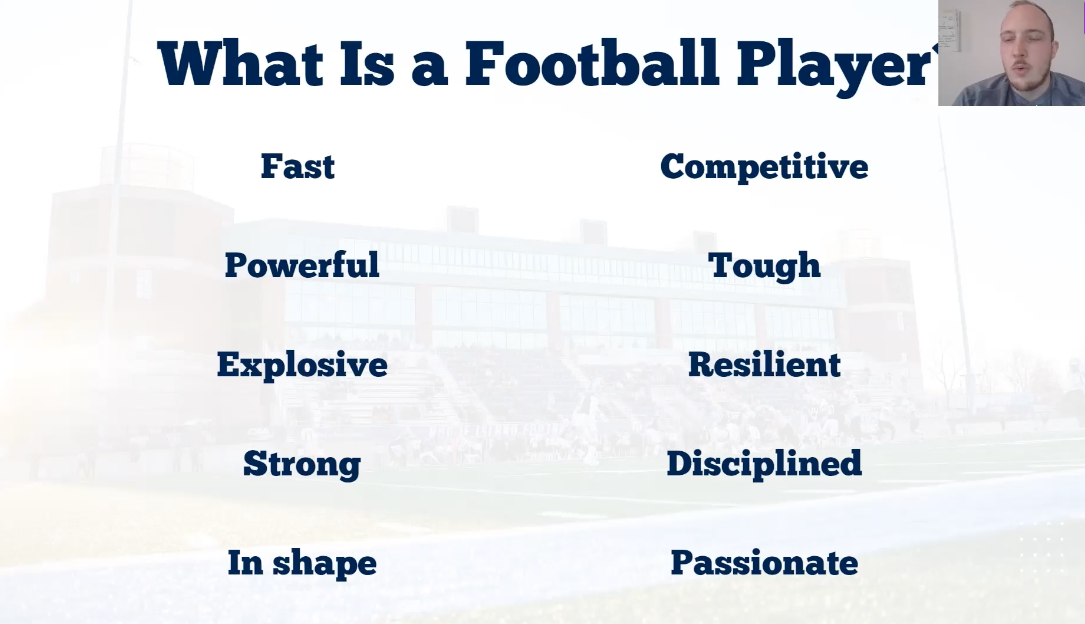
Video: What is a Football Player?
1. Strength isn’t enough—movement decides games
Leech’s biggest shift came from realizing athletes can get stronger without getting more football fast. Acceleration, deceleration, max velocity, and change of direction don’t improve just because you added plates. They improve through intentional field work.
2. Most conditioning ruins sprint mechanics
Leech shows the image of athletes bent over during gassers and asks a hard question:
“Is this how you want your players to run onto the field?”
Gassers teach athletes to survive. They don’t teach posture, knee drive, arm action, or max-velocity mechanics. A field-first model replaces these with sprint habits that actually show up in games.
3. Football is built on habits, not just outputs
In his “outputs and habits” framework, Leech stresses that offseason training must create the specific postures, angles, and movement qualities athletes will repeat in competition. If a drill doesn’t create a habit you want to see under stress, it doesn’t belong in the program.
4. The field builds what the weight room never will
Competitiveness. Resilience. Toughness. Spatial awareness. Contact readiness.
Leech argues that you can get strong under a barbell, but you become a football player on the field. These traits must be practiced in environments that look, feel, and demand the same skill sets as real football.
5. Transfer is now the metric that matters
A strong athlete who can’t accelerate, decelerate, or win in space isn’t a finished product. By connecting general capacities → general skills → specific skills → sport skills, Leech shows how to build training that converts weight-room gains into game-day production.
6. Modern S&C blends data with movement clarity
Today’s best programs use data to identify needs, adjust loads, and build off-seasons backward from fall camp. But the data only matters if it guides what Leech calls “meaningful movement”—work that leads directly to better football.
7. The edge belongs to coaches who make this shift now
Programs adopting field-first systems are seeing better sprint mechanics, healthier squads, and players who look like football players in every rep. The ones holding onto old models are falling behind.
Scott Leech will break down exactly how he uses field work, loaded jump training, and movement-based progression in his session at the Strength on the Gridiron Summit.
If you’re ready to build a field-driven off-season that actually transfers to game day, the Strength on the Gridiron Summit gives you the full blueprint.
Get lifetime access to every session, save $50 before Dec. 1, and step into the modern model that elite programs are already using.
-Coach Grabowski
0 comments