Coach -
Think about the biggest play your quarterback made last season. The one that decided a game. Was it from a clean pocket? Standing tall, no pressure, perfect mechanics, full follow-through?
Probably not. It was probably from a pocket that was collapsing, crowded, or already broken. Fourth and five in the fourth quarter. An unblocked blitzer off the edge. Arms and bodies closing in. The protection was okay, but there was just stuff everywhere.
That's where games are won. And most quarterbacks never practice for it.
Coach Bob Davies starts his clinic Throwing From Broken or Crowded Pockets with a simple idea: if the biggest moments of your season happen from ugly pockets, your quarterback needs to be comfortable in ugly pockets before he ever gets there.
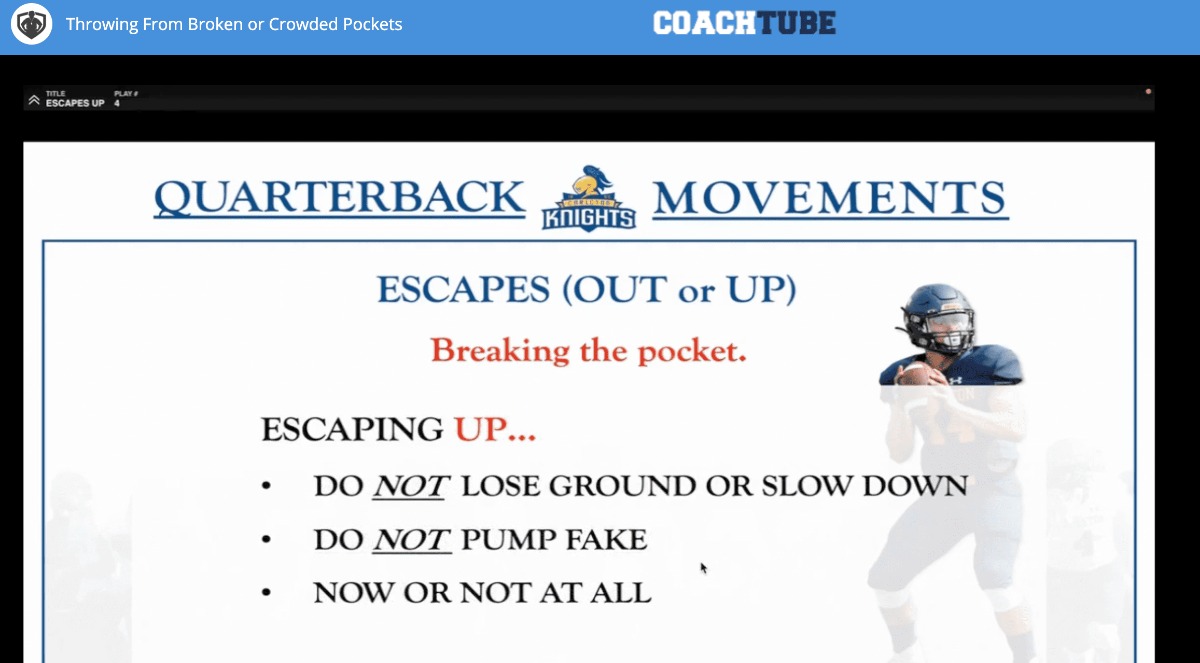
Video: Escaping Up in the Pocket
The Crowded Pocket Problem
Coach Davies is honest about this one. Crowded pockets are hard to drill. You don't want your quarterback's hand hitting a helmet. You don't want to put him at risk. So most coaches just don't drill it. They rep clean drops, clean throws, clean follow-throughs. And then the fourth quarter comes, and the pocket looks nothing like practice.
Davies uses pop-up bags to solve this. They give a physical presence in the pocket without a hard surface. A bag comes back toward the quarterback's hip and he has to cut his release short. He can't finish all the way through. Another bag pops up in his face and he has to adjust his arm slot. It's not about perfecting a throw. It's about getting comfortable making an imperfect one.
Coach Davies pulls game film to show why these reps matter. Fourth and five, fourth quarter, league rival. The pocket is technically fine. The protection holds. But there are arms and bodies squeezing in from every angle, and it's tight and uncomfortable. Can your quarterback stand in there and deliver against tight man coverage? Third and seven, fourth quarter. A blitzer comes clean through the pocket. If Coach Davies made that blitzer a pop-up bag, it's the exact same drill from practice. The physical object in front of the quarterback forcing him to make a throw without a clean pocket.
Fourth and 10, two-minute drill, trailing by a touchdown. Unblocked edge rusher. Third and two in the red zone, play action, a guy falls off a block late and the pocket gets crowded. Every one of these is a rep where the game was on the line, the pocket was ugly, and the quarterback had to deliver anyway. Coach Davies connects each one back to the drill work in his full clinic.
Escaping Up: Ball Comes Out Now or Not at All
Once the pocket goes from crowded to broken, the rules change again. And this is where Coach Davies draws a line most coaches don't.
When a quarterback escapes out of the pocket, he's getting himself into space. He has room. He can pump fake, look downfield, draw the play out and wait for something to develop. The escape buys time.
Escaping up doesn't buy time. It burns it. The quarterback is moving toward the line of scrimmage with more bodies around him, not fewer. He's not getting himself into the clear. There's no room for a pump fake because a pump fake in traffic doesn't move anyone. Every step forward brings the line of scrimmage closer, and one step too many makes the throw illegal.
So the rule is binary: ball comes out now, or it doesn't come out at all.
Coach Davies repeats this on every rep because it's the entire framework for escaping up. He shows it in practice and on film. Third and seven in the fourth quarter, edge rushers collapsing, the quarterback escapes up and gets the ball out immediately for a first down. Third and four, second quarter, pressure again, escape up, ball out. No hesitation. The rule removes the decision-making. The quarterback already knows what to do before the pressure arrives.
When "Not at All" Is the Right Answer
Here's the part most coaches miss. Coach Davies teaches that escaping up turns into a scramble more often than it turns into a throw. And that's fine. That's the design.
The quarterback is already moving forward. Keep it moving forward. Don't mess around trying to be a passer when the situation has already told you the throw isn't there. The "not at all" part of the rule isn't a failure. It's a feature. Tuck the ball. Make yards. The defense has already lost contain if the quarterback is running through the middle of the pocket.
Compare that to escaping out, where the pump fake is a real weapon. Coach Davies shows a rep where the quarterback rolls out, pump fakes, and gets a defender in the air. It works because the quarterback has room to sell it. In the open field, the fake moves people. In traffic, it doesn't. The tools change because the geometry changes.
Coach Davies walks through film of both scenarios in the clip above.
"I bet your guy can make the 5 yard throw. I bet he can make the 10 yard throw."
That's what Coach Davies says in the clip. You don't need exceptional arm talent to operate from a broken pocket. You need a quarterback who's been in that environment before, who's comfortable with bodies around him, and who knows the rules for the type of escape he's in. The arm talent is secondary. The reps and the framework are what keep plays alive when it matters most.
Always be growing,
Coaches Clinic Community of Coaches Helping Coaches
P.S. This email covers the crowded pocket drill work and escaping up, but Coach Davies' full clinic on Throwing From Broken or Crowded Pockets goes much deeper.
0 comments