Coach -
Your quarterback isn't 6'5".
Most aren't. You recruited a kid with accuracy, feel, and some athleticism. He's 6'1". And every time he steps up into a deep U-shaped pocket and tries to throw over the line, you're rolling dice on tips, overthrows, and balls knocked back into the box for interceptions.
Coach Allen Rudolph teaches a different approach. He builds the pass set from the brain down, not the ground up. The result is a pocket that's wider, flatter, and built for the quarterback you actually have. He traces his system back to Chris Strasser, who learned from Coach Howard Mudd, who Coach Rudolph calls one of the greatest offensive line coaches ever to do it. The whole framework lives inside his 12 Factors in Deciding Pre-Snap Spots clinic.
Video: Allen Rudolph - 12 Factors in Deciding Pre-Snap Spots
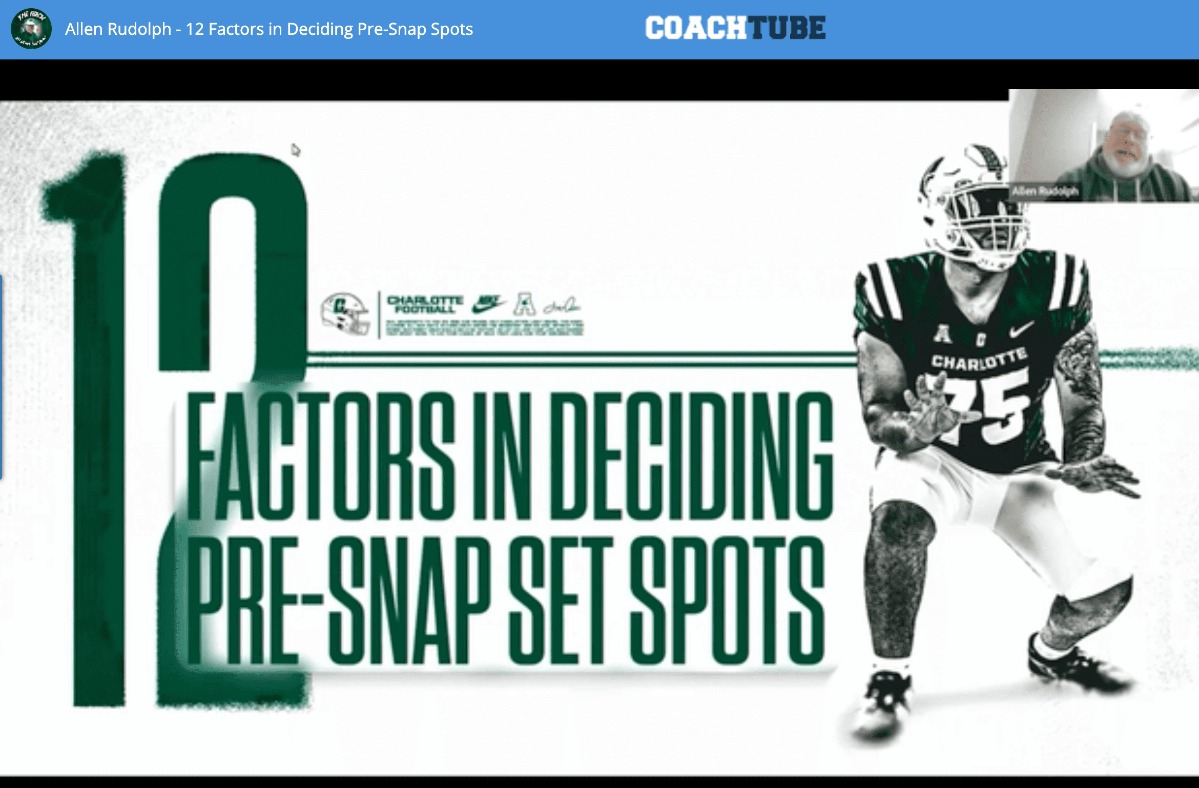
Build the Pass Set From the Brain Down
There are two ways to build pass protection.
Ground up: Stance, hands, kick step, punch. Physical mechanics first.
Brain down: The mental framework that decides where the offensive lineman sets before any of those mechanics fire.
Coach Rudolph teaches both. But the brain-down piece is where he says most protection schemes break, because linemen don't know where the spot is. They know how to set. They don't know where.
That distinction is the entire point of the clinic.
Flatten It, Widen It, Save the Quarterback
Coach Rudolph is direct about the pocket he wants. Not deep and rounded. Flat and wide.
There are two reasons.
Reason one: the quarterback you can actually recruit. Most programs don't land the 6'5" pocket statue who can throw over a defensive line. They get a 6' to 6'1" athlete with accuracy and feel. A deep U-pocket forces that quarterback to release into a wall. A flat, wide pocket lets him see lanes and step into them.
Reason two: tips, overthrows, and the interceptions they cause. Coach Rudolph names it directly. Tips and overthrows create interceptions. The flatter the pocket, the fewer tips. The wider the pocket, the cleaner the follow-through, because the ball isn't getting knocked down by a defensive lineman in the lane. He says his giveaways and interceptions both dropped once they committed to it.
This isn't a stylistic preference. It's a turnover argument.
Aggressive Sets, Never the Same Way Twice
Coach Rudolph is an aggressive setting team. Up the field. Closing the distance on the rusher before the rusher closes it on the quarterback.
The rule he wants every OL coach to hear: it doesn't matter whether you jump set, short set, or angle set. Some coaches call those buckets angle A, angle B, and angle C. Inside each one, there are still different angles of departure from the line of scrimmage. You can never set the same way every time.
He builds the entire decision tree on two principles:
- Every set has a spot: The lineman doesn't just "set." He sets to a location.
- You can never set the same way every time: Patterned sets get pattern-rushed. The rusher reads the spot pre-snap and beats it.
The 12 factors in the clinic are how Coach Rudolph teaches his linemen to pick the right spot, on the right rep, against the right rusher, in real time. He walks through them one at a time in the clip.
The Pre-Snap Spot Is Only Half of It
Coach Rudolph teaches the spot in two phases.
There's a pre-snap spot, decided before the ball moves. And there's a post-snap spot that follows. He says outright that he splits the talk into both halves, and he runs film on each.
Most protection teaching stops at the pre-snap setup. The lineman lines up, sets, and lets technique carry the rep. Coach Rudolph wants the second piece coached just as hard. He's specific in the clip about which post-snap reps he uses to teach it and what he wants his guys to see on the second beat of the rep.
The argument underneath the whole talk is that better hands and better feet don't fix a lineman who doesn't know where he's supposed to be. Spot first. Set second. Technique third. Coach Rudolph builds it in that order because that's the order Howard Mudd built it in, and it's the order that turns a recruitable six-foot quarterback into a starter who isn't throwing tipped picks on Friday.
Always be growing,
Coaches Clinic Community of Coaches Helping Coaches
P.S. This email is the philosophy. The full 12 Factors in Deciding Pre-Snap Spots clinic from Coach Rudolph is the install.
He walks through each of the 12 factors that determine where his linemen set on every rep, breaks down the pre-snap and post-snap spots on game film, and shows how he varies the angle of departure inside jump, short, and angle sets so the protection never hands the rusher the same picture twice.
If your install starts at the feet and your quarterback is still taking hits, the full clinic is the brain-down version of the build.
0 comments