Coach -
We have all been there.
It’s the day after a game. The coffee is cold, the film is rolling, and you are staring at the screen shaking your head.
You’re watching a play blow up and thinking, “Man, we shouldn’t have asked him to do that.”
The worst thing we can do as coaches is ask our guys to do stuff they simply can’t do.
Sean Brophy, the Passing Game Coordinator at North Texas, knows this feeling. And considering he has led UNT to a Top 12 passing offense in the FBS for three straight years, he knows how to fix it.
It starts with how you build your game plan.
1. Build "Resilient Plays"
Too many coaches call what Brophy calls "one-hit plays."
You know the ones. They only work if the defense gives you the exact look, the exact coverage, and doesn't blitz. If they shift? The play is dead.
Instead, Brophy focuses on Resilient Plays.
These are concepts that have built-in answers against multiple looks. This allows you, as the play caller, to sleep better on Friday night knowing your quarterback has a solution, no matter what the defense shows.
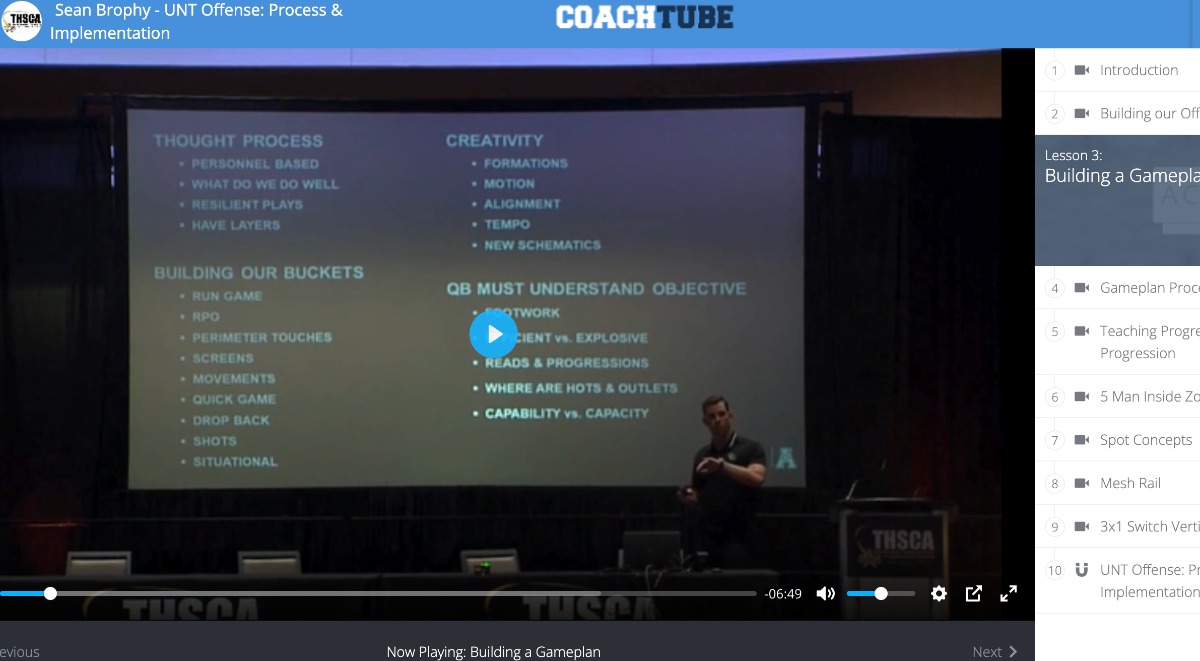
2. The Illusion of Complexity
How do you keep defenses off balance without confusing your own 16-year-old quarterback?
You change the picture, not the process.
Brophy’s goal is to keep the quarterback's reads, footwork, and progressions the exact same week to week.
He creates the illusion of complexity by using window dressing:
- Different formations
- Motions and shifts
- Tempo changes
To the defense, it looks like a new headache. To your QB, it looks just like Tuesday practice.
3. Capability vs. Capacity
This is a concept Brophy picked up from Sean McVay, and it changes how you evaluate your QB.
There is a massive difference between the two:
- Capability: Can he memorize the play? Can he draw it up on the whiteboard? That’s the first step.
- Capacity: Can he process the information in the heat of the moment?
When the safeties shift and the pressure comes, does he have the capacity to be a problem solver?
Brophy’s entire system is designed to bridge the gap between whiteboard capability and game-day capacity.
He breaks down UNT’s process for implementing their high scoring offense in his jam packed clinic talk from last year THSCA Coaching School: Sean Brophy - UNT Offense: Process & Implementation
Always be growing,
Coaches Clinic Community of Coaches helping Coaches
P.S. Brophy did a study of over 900 clips regarding quarterback movement. He found there were only seven negative plays—less than 1%.
0 comments