Coach ,
When you start putting together a plan to stop RPOs, it’s easy to get overwhelmed by all the variations. You see the glance, the gift, opposite side reads, and the old-school bubbles.
Coach Vass believes your plan should be dictated by a few specific questions. If you don't ask them, you end up defending "ghosts"—schemes the opponent doesn't even run.
Part 1: Questions and Musts
Video: Questions, Musts, and Menu
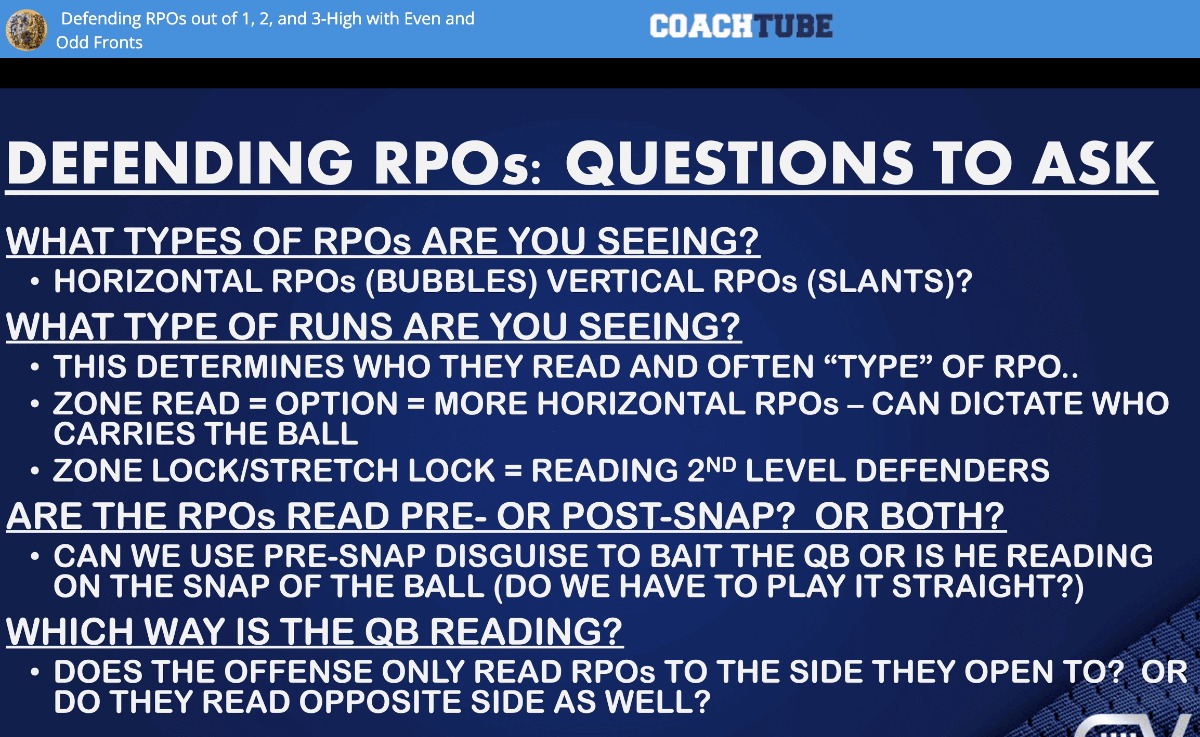
Here is how Coach Vass analyzes RPO threats before he ever draws up a front or a coverage.
1. What type of RPOs are they?
Are you seeing horizontal RPOs like bubbles, or vertical threats like slants and glances? Usually, the run game tells the story. Zone read teams usually want the bubble. Teams running "Zone Lock" (where the tackle blocks out) are usually reading second-level defenders for those vertical routes.
2. Is the read pre-snap, post-snap, or both?
If they’re just taking the "gift" route because your corner is playing off, that's a pre-snap problem you can solve with alignment. If they read it on the fly, you have to decide if disguise is a tool you can actually rely on.
3. Which way is the QB looking?
Vass has found that most opposite-side pulls are pre-snap reads. You can often talk an offense out of that play just by how you align.
Coach Vass’s Defensive Musts
Before you get into the "Menu," Coach Vass highlights three non-negotiables:
Gap Soundness: You must account for every gap, whether you are "fitting" gaps or "ball fitting" with linebackers who tempo the back.
The DE to the Back: He has to know if he’s sitting for the QB or chasing the dive. If he gets a base block, is he ripping inside or keeping his outside arm free?
Overhang Clarity: Every overhang defender must know if they are in or out of the run fit. In general, if you’re 4-down/2-high or 3-down/1-high, the overhang to the back is out of the fit, and the overhang away is in.
Part 2: The Coverage Menu
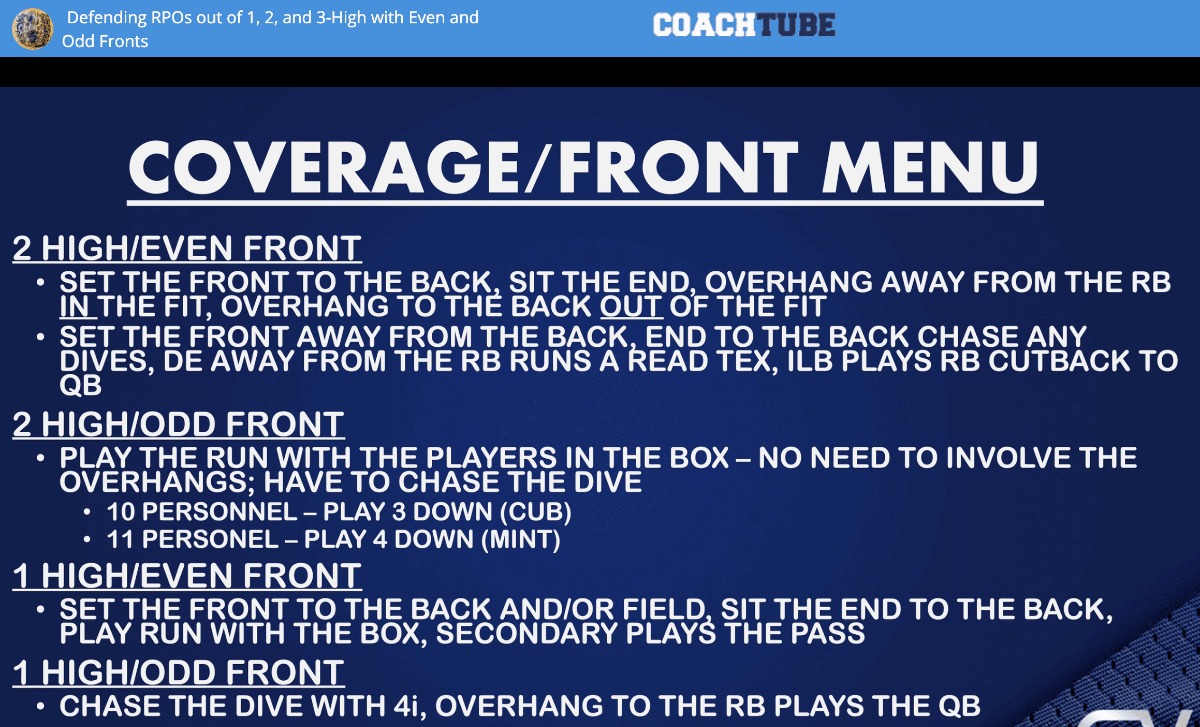
Once you have your "musts" established, Coach Vass moves into the actual structural answers. He breaks this down by front and shell:
2-High, Even Fronts
Vass likes to set the front away from the back. This allows the End to the back to chase the dive. Meanwhile, the End away from the back runs a "Reed Stunt" to play the interior gap. This pushes the inside linebacker over so he can play the QB instead of being buried in an interior gap.
2-High/3-High, Odd Fronts
On paper, you should be able to play the run with just the guys in the box. Vass notes that you don't necessarily need to involve the overhangs here, but involving the overhang away from the back makes life easier. In 10-personnel, he utilizes a "Cub" front (4i-0-4i) to keep defenders off the ball and let them play fast.
1-High, Even Fronts
Here, Vass sets the front to the back or the field. If the End is to the 3-technique side, they sit. The interior box handles the run. Since you’re gapped out, the Mike takes the A-gap and the Will takes the B-gap.
1-High, Odd Fronts
This looks a bit different. Vass has the 4i chase the dive. The overhang to the back stays out of the fit—meaning he is the primary extra defender on the QB if he pulls the ball.
Vass acknowledges there is a lot of nuance here. If some of these front/coverage rotations seem like they contradict, it's usually because of specific situational adjustments he covers in the film.
He dives much deeper into the diagrams and game tape plus all the tools you could ever need in his clinic HERE.
Always be growing!
Coaches Clinic Community of Coaches Helping Coaches
0 comments