

From Middle America to the Ends of the Universe
Happy Wednesday!
Happy March, everyone. We’re at the cusp of pollen season here in Houston. By the end of the month, cars parked outside overnight will get quarter-inch layers of live oak pollen by morning. People are already sniffling and sneezing.
What does this time of year bring to your part of the world? Hit reply and let me know.
Writing proceeds on Toffib War Book 1. I'm stretching my creative muscles on this one. It’s a much tighter setting than I usually write - twelve men (plus one alien), a few days, a hundred kilometers trekking across a single extraterrestrial biome.
Speaking of extraterrestrial biospheres‥.
More unscientific than FTL
Science fiction readers and writers alike know that faster-than-light (FTL) travel is almost certainly impossible. Einstein’s theories explain the orbit of Mercury and are used by GPS for accurate mapping, so, while it’s possible his theories are wrong, they’ve held up to every test so far.
For that reason, writers who add FTL to their universes will furiously handwave an explanation or throw out some jargon. Hyperspace, warp drive, jump points. You’ve read all those and more.
Because readers know FTL is impossible, writers must tackle Einstein’s theories head-on to get readers to suspend disbelief.
But there’s something else that’s almost certainly impossible. Not for reasons as rigorous as the math behind Einstein’s theories, but out of simple probability. What’s worse, most writers who know they have to explain why Einstein was wrong aren’t even aware they should be doing the same for the near-impossibility I’m talking about.
You’ve read or seen this near-impossibility a hundred times. When a character comes down with Rigelian fever or Denebian flu. When a human being and an alien share a meal. When settlers on a life-bearing planet domesticate native plants and animals. When humans and aliens mate.
Yes, even if their child is Spock.
In short, life from different origins would be incompatible.
Living things from one planet can't eat or be eaten, get sick or sicken, or reproduce with their counterparts from another.
I won’t go into details. You probably don’t care about the handedness of amino acids. The arbitrariness of the genetic code. We have no reason to believe life from other origins would even use DNA as its genetic material!
My science fiction generally reflects this. Most of my settled worlds bore no life when humans arrived, and what life they have is in terrestrial ecosystems planted by the colonists. In the rest, terrestrial and alien biospheres are incompatible. If terrestrial life lands on an alien world, it won’t be an invasive species; it will only survive in the shelter of human gardens.
The Toffib War and future titles set in that universe fit this paradigm too.
But…
I’m willing to play contrarian.
- What if, instead of slowing atmospheric CO₂ emissions by using wind and solar power, we switch to nuclear and have enough energy to convert CO₂ to synthetic diamond?
- What if dark matter doesn’t exist, and instead, gravity at the galactic scale does things too subtle for us to notice in our laboratories?
- What if evolution takes place, not by natural selection or genetic drift, but by panentheistic Lamarckianism?
And back to today’s theme:
- What if all life in the galaxy, or even the universe, was compatible?
Cosmological what-ifs
Assuming the Big Bang theory is accurate, when the universe was about 4 million years to about 15 million years old, its average temperature cooled from 212°F to 32°F.
In other words, for about 10 million years, all the water in the universe was in liquid form.
Just what we need to support life as we know it.
Imagine life arising in this warm epoch and permeating the universe. When things cooled, some living things clung to footholds on planets orbiting warm stars, while others lay dormant in deep space for billions of years before seeding worlds like Earth.
If you've heard the term "panspermia," then you know what I'm talking about. And let me know where you heard it. A fact article by an astronomer like Fred Hoyle? A science fiction story? Hit reply, I'd love to learn more.
Nifty idea? Yes!
Plausible?
Well…
Water can only be in liquid form if you have water in the first place.
As we all know, water requires two elements: hydrogen and oxygen.
Hydrogen was around from microseconds after the Big Bang. No problem there.
Oxygen, though, first came into existence in the cores of the first stars. Which, as best understood by contemporary cosmology, formed about 100 million years after the Big Bang. Long after the universe was too cold for liquid water.
But what if contemporary cosmology is wrong?
The James Webb Space Telescope has found the oldest known galaxy, hundreds of millions of years older than the previous record holder.
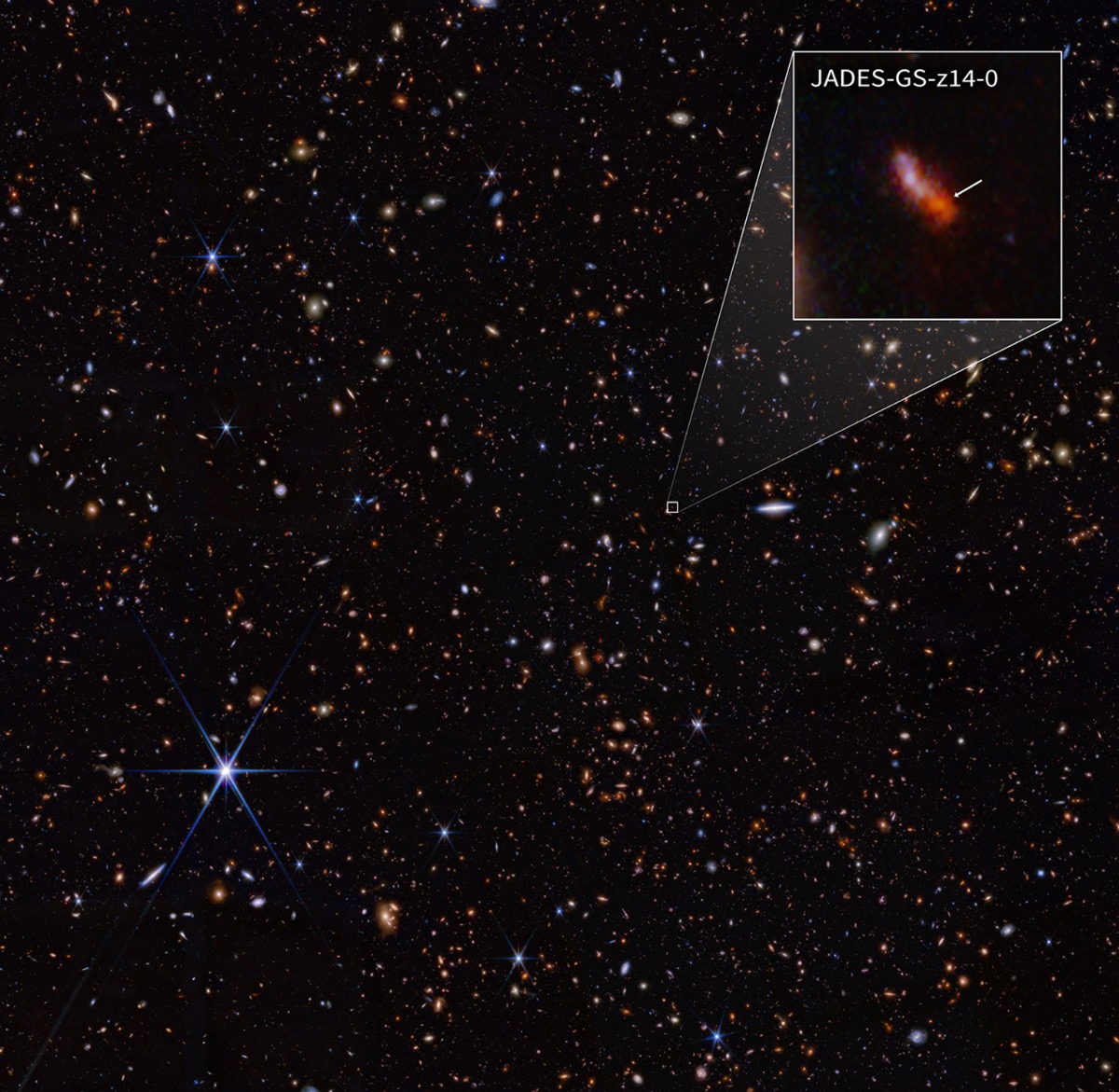
Image: NASA, ESA, CSA, STScI, Brant Robertson (UC Santa Cruz), Ben Johnson (CfA), Sandro Tacchella (Cambridge), Phill Cargile (CfA)
True, the galaxy in the JWST image doesn’t date back to the liquid water epoch, but that’s just one image. What more might be out there?
I’ll leave it at that. Pure speculation, sure, but running with ideas like this is just me doing my job.
And I promise, when I write novels set in a galaxy where all life is compatible, I will handwave and throw out as much jargon as any hard SF writer describing FTL travel.
Speaking of me doing my job, I have more Toffib War Book 1 to write…
Till next time,
Happy Reading!
Raymund
0 comments