❣️🚀 Choosing how to publish your romance novel. And why "just self-publish" isn't a real plan (1.5)
May 20, 2026 12:01 pm
Hello ,
This is the last lesson in Module 1.
Have you replied to any of the emails up to now, to tell me something you learned? If not, please give me an idea for what I should add to Module 1 to make it more valuable to you.
On to lesson five. The last one of this module.
1.5 Traditional vs self-publishing in the romance genre
Let’s get something out of the way right at the start: this lesson is not going to tell you that self-publishing is better than traditional publishing. It’s going to give you an honest, clear-eyed picture of both paths so you can make the decision that’s right for you, your book, and your goals, because those three things are not the same for everyone.
That said, the subtitle of this program is Self-Publishing Your Romance Novel, so you’ve already made at least a provisional choice. What this lesson will do is make sure that choice is an informed one and give you a solid understanding of the traditional publishing world, because knowing how it works makes you a smarter self-publisher regardless of whether you ever pursue it.
How traditional publishing works
Traditional publishing (which I will refer to as “trad publishing”) is the model most people picture when they imagine becoming an author. You write a book, you get an agent, the agent sells your book to a publisher, the publisher produces and distributes it, and you receive an advance against future royalties.
That’s the broad strokes. Here’s what it actually looks like in practice.
The query process
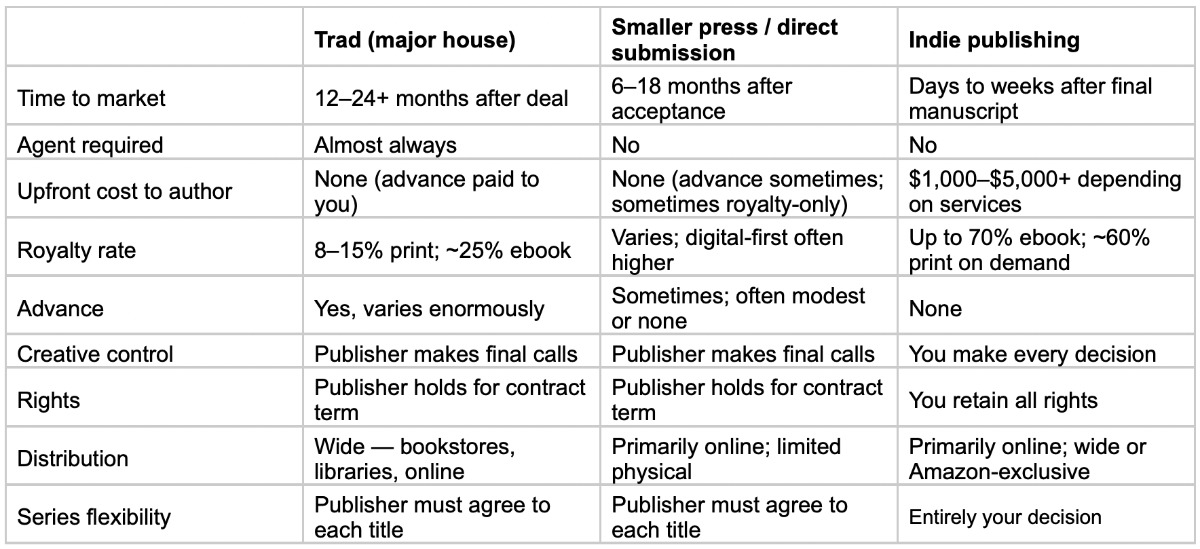
To pursue traditional publication at a major house, you first need a literary agent. With very few exceptions, major publishers don’t accept unsolicited manuscripts directly from authors. Finding an agent requires writing a query letter: a one-page pitch that summarizes your book, establishes your credentials, and convinces a busy professional to request pages. Most agents receive hundreds of queries per week. Acceptance rates are typically in the very low single digits. The query process can take anywhere from several months to several years.
The submission process
Once you have an agent, they submit your manuscript to editors at publishing houses on your behalf. This process also involves waiting, sometimes a very long time. Publishers acquire books on their own schedules, driven by their seasonal lists, their budget, and the tastes of their editorial teams. An editor might love your book but be unable to acquire it because their publisher already has something too similar releasing that year.
The advance and royalty structure
If a publisher offers you a deal, you receive an advance: an upfront payment against future royalties. For a debut romance author at a mid-sized publisher, that advance might range from a few thousand dollars to tens of thousands. At a major publisher, advances for debut romance can be higher, though they vary enormously. You don’t receive additional royalty payments until your book has “earned out,” meaning until sales have generated enough royalty income to repay the advance. Trad publishing royalty rates are typically 8–15% on print and 25% on ebooks, significantly lower than the 70% available to self-publishing authors.
The timeline
After a deal is signed, the road to publication is long. Editing, cover design, cataloguing, distribution setup, and marketing planning all take time within a publisher’s production schedule. The average time from signed deal to bookshelf is 12–24 months. Some debut authors wait longer.
What the publisher controls
In a trad deal, the publisher owns the production of your book. That means they make the final decisions on your cover, your title, your release date, your price point, and in most cases your marketing budget, which for debut romance authors is often very limited. You retain the copyright to your story, but the publisher holds the publishing rights for the duration of the contract.
One thing worth understanding before you sign any trad publishing contract: how “in print” is defined. Many older contracts defined a book as in print when a physical edition existed, which meant authors could reclaim their rights when the print run sold out. Modern contracts often define “in print” to include digital availability which can effectively keep your rights with the publisher indefinitely, even if the book is generating almost no income.
Unless your contract includes a specific sales threshold reversion clause. That clause specifies that if your book sells fewer than a defined number of copies in a given period, you can request your rights back. Without it, your book can sit in a publisher’s digital catalogue earning you almost nothing while you’re unable to do anything with it.
Know what you’re signing before you sign it.
The middle ground: publishers who accept unagented submissions
The trad publishing path described above leads to the major houses: Penguin Random House, HarperCollins, Simon & Schuster. But it’s not the only route into trad publishing, and for romance authors in particular there is a meaningful middle ground worth knowing about.
A significant number of romance publishers accept direct submissions from unagented authors. This is particularly relevant in romance because the genre has a long and healthy tradition of smaller and mid-sized publishers who built their entire business around romance and who actively want to hear from new voices.
Entangled Publishing
is one of the most prominent examples. Their imprints cover a wide range of heat levels and sub-genres—Amara for mainstream contemporary and historical romance, Brazen for steamy romance, Bliss for sweet romance—and they accept submissions directly through their website.
Harlequin
(now an imprint of HarperCollins) has historically been one of the most accessible trad publishers for unagented romance authors. Many of their series lines accept direct submissions and publish detailed guidelines for each line on their website. Harlequin’s series romance model is highly structured. Each line has specific heat level, length, and trope requirements and for authors whose work fits those parameters it’s a well-established and legitimate route to publication.
Kensington Publishing
accepts submissions in several romance categories and has a history of working with debut romance authors.
Sourcebooks Casablanca,
Sourcebooks’ romance imprint, is another mid-sized publisher with a strong romance list and some significant debut successes.
Beyond these, there are over 50 smaller romance presses and digital-first publishers that accept unagented submissions. I created a list of all the publishers that accept queries directly from romance authors that I update annually. You can access and copy the spreadsheet here.
A few things worth knowing before you submit to any publisher directly:
- Read the submission guidelines carefully and follow them exactly. Publishers who accept unagented submissions receive an enormous volume of queries. Submissions that don’t follow the guidelines are frequently rejected without being read.
- Understand the contract before you sign anything. Without an agent reviewing your contract, you’re responsible for understanding what you’re agreeing to. At minimum, know what rights you’re granting, for how long, and what the reversion clause looks like. ALLi and the Authors Guild both have resources to help authors understand publishing contracts.
- Royalty rates and advances vary enormously among smaller presses. Some offer modest advances; many offer no advance at all, with higher royalty rates in exchange. Digital-first publishers often offer strong ebook royalty rates but limited print distribution. Know what you’re evaluating before you compare offers.
- Timeline is still longer than self-publishing. Even at a smaller press that moves quickly, you’re looking at months between acceptance and publication—and you’ll have less control over your cover and marketing than you would self-publishing.
None of this is a reason to avoid smaller press submission. For the right book and the right author, it can be an excellent path. It’s a reason to go in with clear eyes and good information.
What self-publishing actually means
Self-publishing (I prefer the term “indie publishing” since we rarely publish by ourselves...) means you are the publisher. You make every decision, you bear every cost, and you keep the lion’s share of every sale.
In romance specifically, indie publishing has moved so far from its early reputation as a “last resort” that it’s now the dominant model among the genre’s highest-earning authors. The infrastructure available to indie romance authors in 2026—professional cover designers who specialize in genre, experienced romance editors, distribution platforms that put your book in front of millions of readers within 48 hours—is mature, accessible, and genuinely excellent.
Here’s what indie publishing requires from you.
Upfront investment.
You’re responsible for all production costs: editing, cover design, formatting, and any marketing spend. For a romance novel, a realistic minimum budget for a professional result starts at around $1,000–$1,500 USD and can go significantly higher depending on your editing needs and cover designer. I cover budgeting in detail in Module 7: Your Book Launch Plan.
Business ownership.
Indie publishing means running a small business. You manage your publishing accounts, track your expenses and royalties, handle the tax implications of author income, and make strategic decisions about pricing, distribution, and marketing. Some authors find this genuinely energizing. Others find it overwhelming. Knowing which camp you’re in is part of making a clear decision about which path suits you.
Creative control.
Every decision is yours—your title, your cover, your release date, your price, your categories, your keywords, your series arc, your backlist strategy, your ARC campaign… For many authors, this level of control is the single most compelling argument for indie publishing: the ability to respond quickly to reader feedback, update a cover that isn’t working, price strategically during a launch, and own every aspect of your reader relationship.
Speed.
You can move from a finished, edited manuscript to a published book available for purchase in days. You can publish multiple books per year if your writing pace supports it. In romance, where readers are voracious and series momentum matters enormously, publishing speed is a genuine competitive advantage.
A direct comparison
The hybrid path
xo Danika
PS—The places authors most often get stuck at this stage are the income and business ownership questions.
PPS—Want full access to the full Romance Your Launch program in one place, all the worksheets, small group support calls, and a community of romance authors who are building this alongside you?
Already a member of Author Ever After?
Your Module 1, Lesson 5 worksheet is in the course library.
What the worksheet helps you create
The Lesson 5 worksheet inside Author Ever After walks you through the five decision questions I detail in the blog post (Making the decision that's right for you), looks at the smaller press path if that's on your radar, runs you through a vanity publisher checklist, and lands you on a publishing path statement you can carry into the rest of the course and refine as you go.
It may not be a perfect answer, and it doesn't need to be. It just needs to be yours, made with clear eyes and honest priorities, not the ones that sound most impressive at a dinner party.
If you're genuinely torn between paths—or if a conversation with someone who's navigated a hybrid or small press deal would help you think it through—bring that question to the community. It's exactly the kind of conversation that happens well in a room full of people who are facing the same decision at the same stage.

Danika Bloom
* USA Today bestselling romance author
* President, Emerald City Romance Writers
Publishing Mentor: AuthorEverAfter.com
Author: DanikaBloom.com
Founder: Swoonworthy Services
Conversations: YouTube
With respect and gratitude, I operate on the traditional, ancestral, and unceded territory of the Skwxwú7mesh (Squamish) Nation.