Coaching With Clarity: Aligning Training With Who Your Client Wants to Be
The January Misalignment Problem
Every January, trainers face a predictable scenario: clients arrive with ambitious, competing goals—strength, fat loss, endurance, mobility, performance, pain-free movement—expecting simultaneous progress across all fronts.
Your competitive advantage isn't offering more programming options. It's providing the strategic clarity clients need to achieve meaningful results.
This edition of Trainer Edge explores identity-based coaching: a framework that transforms vague aspirations into coherent training strategies. When programming aligns with a client's target identity rather than a scattered list of desires, three critical outcomes improve:
- Adherence increases – clients understand the "why" behind each session
- Expectations become realistic – trade-offs are transparent from the start
- Results compound – focused effort accumulates instead of dissipating
The Identity-First Coaching Framework
Core Principle: Identity Determines Training Priorities
The framework below serves dual purposes:
- As a coaching conversation tool during client intake and goal-setting
- As a program design filter that guides your training decisions throughout the year
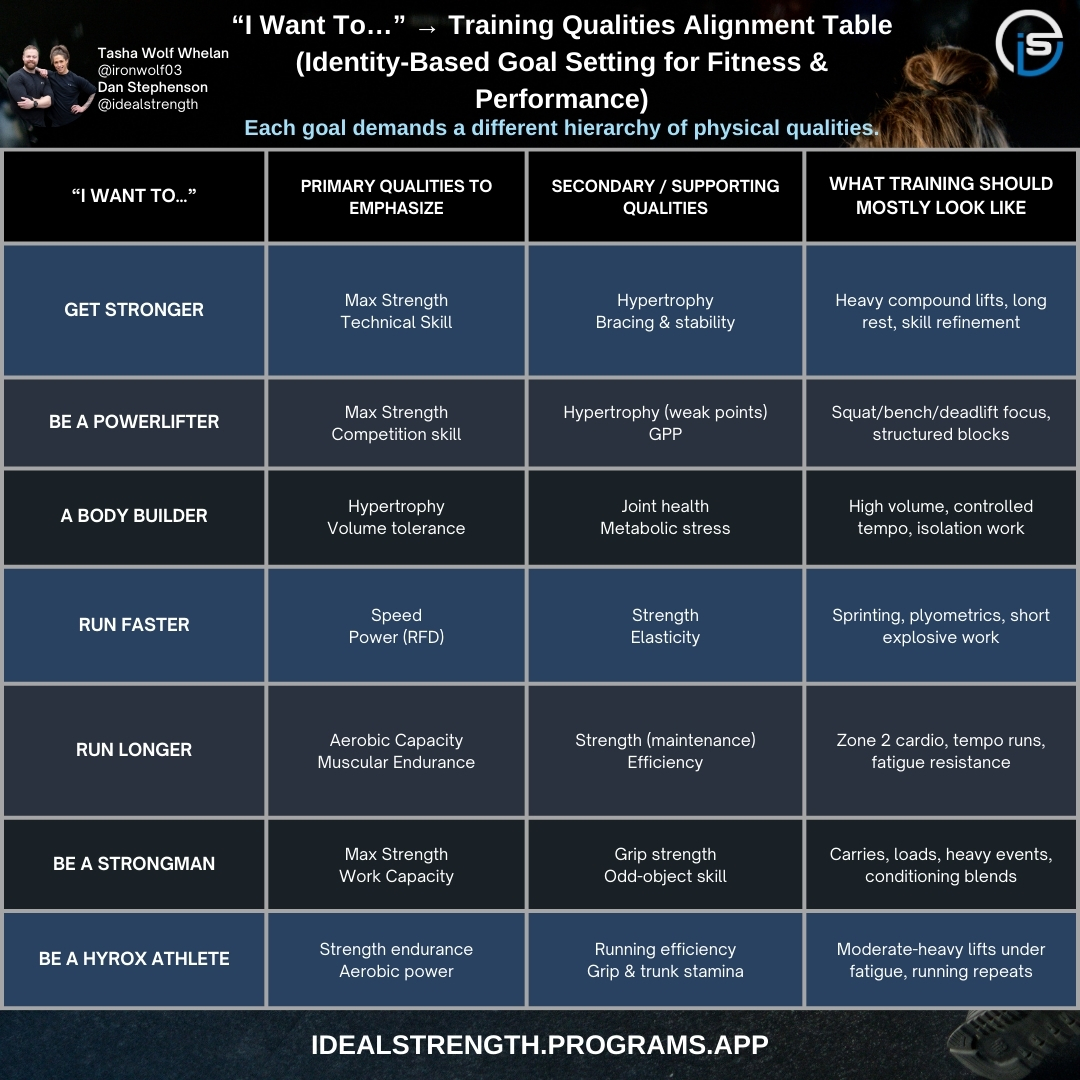
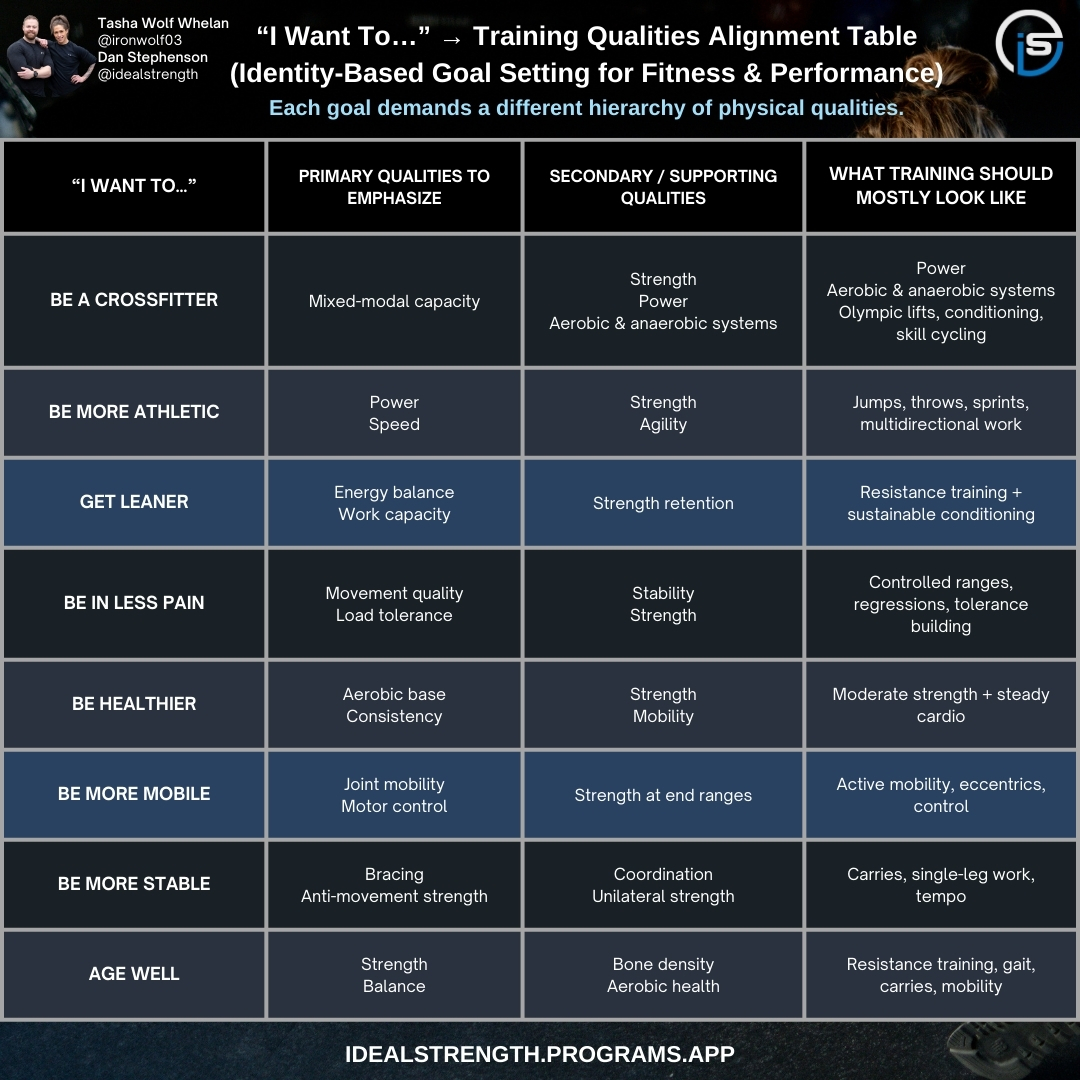
Use this table to translate client aspirations into training realities:
Key Elements Explained:
- "I Want To…": The identity or outcome the client is pursuing
- Primary Qualities to Emphasize: These receive 60-70% of training volume and attention
- Secondary/Supporting Qualities: These receive 20-30% and prevent regression in other areas
- What Training Should Mostly Look Like: The practical session structure that emerges from these priorities
Why Strategic Clarity Matters: Three Critical Insights
1. Physiological Interference Is Real
Certain training adaptations compete at the biological level. Understanding these conflicts allows you to structure programs that minimize interference while managing client expectations.
Hypertrophy vs. Endurance
Concurrent training blunts muscle growth through AMPK/mTOR pathway interference. This effect is most pronounced when strength and endurance work occur in the same session or within 6 hours of one another. Strategic session separation—such as morning strength training and evening cardio—can reduce but not eliminate this interference, especially at higher training volumes.
Strength Peaking vs. High-Volume Conditioning
Sustained aerobic work impairs power development and CNS recovery capacity. Attempting to peak strength while maintaining high conditioning volumes creates competing adaptive signals.
Mixed-Modal vs. Single-Sport Specialization
CrossFit-style training and powerlifting optimization require fundamentally different stress distributions. Simultaneous pursuit of both produces suboptimal outcomes in each domain.
Coaching Takeaway: This framework helps clients understand that focused training isn't a limitation—it's a biological requirement for optimal adaptation.
2. The Real Adherence Barrier: Misalignment, Not Motivation
Most training failures stem from structural problems, not character defects:
- Training qualities don't support the stated identity goal
- Weekly programming stress exceeds lifestyle capacity
- Client expectations don't match physiological timelines
Reframing adherence as an alignment problem removes unnecessary guilt and focuses attention on the actual issue: is this program designed for the person this client is trying to become?
3. The Specificity-Breadth Trade-Off
Coaching Rule: The more specific the target identity, the narrower the training priorities must become.
- General health goals → Broad qualities across multiple domains
- Sport-specific identities → Tightly prioritized qualities with conscious sacrifices elsewhere
This isn't a failure of program design—it's how adaptation works.
Strategic Application: What NOT to Prioritize
Understanding what to deliberately deprioritize is as important as knowing what to emphasize.
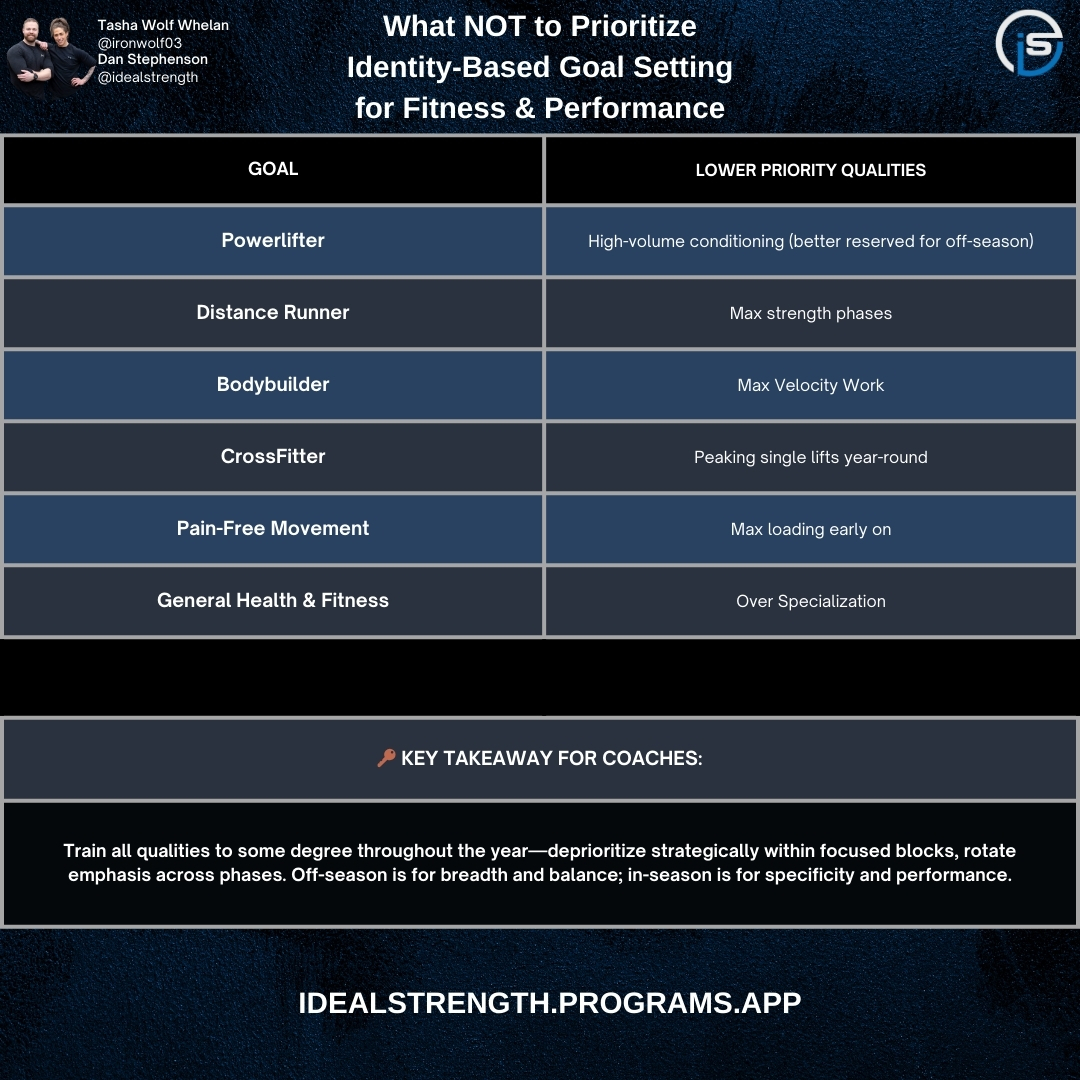
Coaching Note: These aren't permanent eliminations. They're strategic reprioritizations during focused training blocks. Maintenance doses may still be appropriate depending on individual needs.
Implementing Identity-Based Coaching: The Four Touch-points
1. Client Intake & Goal-Setting
Introduce identity language early: "Describe who you want to be in 6 months" yields better information than "What are your goals?"
2. Phase Transitions
Revisit the identity framework during deload weeks or when shifting training blocks. This prevents program drift and maintains strategic alignment.
3. Programming Justification
Use the framework to explain why certain qualities receive emphasis while others don't: "We're prioritizing X because you're building toward Y identity.
4. Expectation Management
Anchor program changes to identity evolution, not arbitrary variety or trends. This builds trust and reduces confusion during necessary adjustments.
Sample Training Blocks: From Identity to Implementation
Below are evidence-informed training examples matched to specific client identities, plus intelligent transition strategies that preserve momentum while managing fatigue and preventing stagnation.
Example 1: General Strength Development
Target Identity: "Get Stronger"
Duration: 4–6 weeks
Primary Focus: Maximal Strength + Technical Skill
Structure:
- Frequency: 3–4 sessions/week
- Core Movement Pattern: Squat, hinge, horizontal press, vertical pull
- Loading: 3–5 reps, 3–6 sets at 80-90% 1RM
- Rest Intervals: 2–4 minutes between compound sets
- Conditioning: Maintenance dose via low-impact, low-intensity modalities (walking, cycling, swimming) that support recovery rather than compete with strength adaptation
Accessory Emphasis:
- Hypertrophy work for muscle groups supporting primary lifts
- Bracing and positional drills (paused reps, tempo variations)
Session Characteristics:
- Fewer total exercises (4-6 per session)
- Longer session duration due to rest requirements
- High intent and focus on every working set
Intelligent Transitions:
- → Powerlifting Specialization: Narrow exercise selection to competition lifts and close variations; introduce structured periodization
- → Body Composition Focus: Maintain 2x/week strength emphasis; add 2-3 low-impact conditioning sessions
- → Pain-Free Movement: Reduce external load 30-40%; increase tempo control and time under tension
Example 2: Powerlifting Competition Preparation
Target Identity: "Be a Powerlifter"
Duration: 6–8 weeks (within larger 12-16 week cycle)
Primary Focus: Maximal Strength + Competition Specificity
Structure:
- Frequency: 3–5 sessions/week
- Competition Lifts + Variations: Back squat, bench press, conventional/sumo deadlift, plus their close variations (pause work, tempo lifts, different bar positions) and direct support exercises receive 70% of training volume
- Intensity Management: Planned wave loading using RPE or percentage-based systems
- Accessory Work: Targeted to individual weak points (lockout strength, start position, sticking points) and injury prevention
Session Characteristics:
- Highly structured with minimal autoregulation
- Specific bar speed and RPE targets for each set
- Reduced exercise variety compared to general strength phases
Intelligent Transitions:
- → Off-Season Strength: Broaden exercise selection; increase hypertrophy volume; reduce competition specificity
- → General Health Emphasis: Decrease intensity to 70-75% ranges; expand aerobic base work; introduce movement variety
- → Injury Rehabilitation: Temporarily regress movement complexity; reduce spinal loading; maintain accessory volume where appropriate
Example 3: Sprint Speed Development
Target Identity: "Run Faster"
Duration: 4–6 weeks
Primary Focus: Maximal Velocity + Rate of Force Development
Structure:
- Sprint Work: 1–3 sessions/week with full recovery (48-72 hours between)
- Plyometric Training: Low-volume, high-intent jumps and bounds
- Strength Work: Heavy compounds (3-5 reps) maintained 2x/week at reduced volume
- Recovery Requirements: Complete CNS recovery between quality sessions
Session Characteristics:
- Short total working time (20-30 minutes of quality work)
- High intensity, low volume
- Sessions end when output quality degrades
Intelligent Transitions:
- → Endurance Development: Gradually reduce sprint frequency; build aerobic base through Zone 2 work
- → General Athleticism: Add multidirectional change-of-direction drills; introduce rotational power
- → Strength Emphasis: Increase lifting volume 40-60%; reduce sprint session frequency to 1x/week maintenance
Example 4: Endurance Base Building
Target Identity: "Run Longer"
Duration: 6–10 weeks
Primary Focus: Aerobic Capacity + Muscular Endurance
Structure:
- Aerobic Work: Zone 2 cardio 2–4 sessions/week (conversational pace, nasal breathing)
- Tempo Work: 1x/week at threshold intensity
- Strength Maintenance: 2 sessions/week, reduced to 2-3 compound lifts per session
- Volume Management: Gradual weekly mileage increases (10% rule)
Session Characteristics:
- Emphasis on consistency over intensity
- Minimal maximal-effort training
- Focus on movement efficiency and economy
Intelligent Transitions:
- → Speed Development: Introduce sprint mechanics and hill work; add Olympic lift variations for power
- → Body Composition: Maintain cardiovascular base; increase resistance training density and metabolic work
- → General Health: Reduce total volume 20-30%; broaden movement pattern variety
Example 5: Strongman Event Training
Target Identity: "Be a Strongman"
Duration: 4–6 weeks
Primary Focus: Maximal Strength + Work Capacity
Structure:
- Heavy Compound Lifts: Squat, deadlift, overhead press variations
- Event Work: Carries (farmer's, yoke), loading (stones, sandbags), pushing/pulling (sled, truck)
- Conditioning Blends: Event-specific circuits with incomplete recovery
- Grip Emphasis: Integrated throughout all sessions
Session Characteristics:
- High overall fatigue from combined demands
- Significant grip and core taxation
- Mix of absolute strength and strength-endurance
Intelligent Transitions:
- → General Strength: Remove event work; focus exclusively on fundamental strength development
- → Pain-Free Movement: Maintain carry variations with lighter loads; reduce spinal compression exercises
- → Athletic Development: Add velocity-based work; introduce agility and coordination drills
Example 6: Mixed-Modal Conditioning
Target Identity: "Be a CrossFitter"
Duration: 4–6 weeks
Primary Focus: Mixed-Modal Work Capacity
Structure:
- Olympic Lifts: Technical practice and moderate-load complexes
- Conditioning: 2–4 sessions/week combining aerobic and anaerobic demands
- Strength: Maintained through abbreviated lifting sessions
- Skill Cycling: Gymnastics movements, barbell complexes, monostructural cardio
Session Characteristics:
- Planned variety (not random)
- Overlapping energy system demands
- Technical skills under fatigue
Intelligent Transitions:
- → Body Composition: Reduce workout intensity; increase sustainability and consistency
- → Strength Specialization: Strip conditioning volume; narrow lifting focus to primary compounds
- → Recovery/Health: Lower overall stress load; increase session spacing; add restorative modalities
Example 7: Hypertrophy Accumulation
Target Identity: "Be a Bodybuilder"
Duration: 6–8 weeks
Primary Focus: Muscle Growth + Mind-Muscle Connection
Structure:
- Training Volume: 12-20 sets per muscle group per week
- Tempo: Controlled eccentrics (3-4 seconds) and deliberate concentrics
- Exercise Selection: Emphasis on isolation movements and machine work for safety and focus; variety of angles and muscle lengths (stretched, mid-range, shortened positions) for complete muscular development
- Rest Periods: 60-90 seconds to balance metabolic stress and mechanical tension
Session Characteristics:
- Prioritize muscular contraction quality over load
- Joint-friendly exercises and ranges of motion
- Minimal conditioning to preserve recovery capacity
Intelligent Transitions:
- → Strength Development: Reduce volume 40-50%; increase load to 85-90% ranges; extend rest periods
- → Body Composition: Maintain training volume; add 2-3 low-impact conditioning sessions
- → General Health: Reduce weekly set volume; add steady-state aerobic work; expand movement variety
Example 8: Athletic Power Development
Target Identity: "Be Athletic"
Duration: 4–6 weeks
Primary Focus: Power Expression + Speed + Agility
Structure:
- Explosive Work: Jumps (bilateral/unilateral), throws (medicine ball variations), sprint work
- Strength Maintenance: 2 sessions/week focusing on rate of force development
- Multidirectional Movement: Cutting, lateral shuffles, deceleration training
- Coordination: Movement complexity and variability
Session Characteristics:
- Dynamic preparation (15-20 minutes)
- Explosive intent on every rep
- Low grinding or sustained effort
Intelligent Transitions:
- → Sport-Specific Training: Narrow skill set to sport demands; increase specific conditioning
- → Longevity Focus: Reduce jump volume; maintain coordination work at lower intensities
- → Strength Emphasis: Increase barbell loading; reduce velocity-based work
Example 9: Movement Restoration
Target Identity: "Move With Less Pain" / "Feel Better Day-to-Day"
Duration: 4–6 weeks (often ongoing with progressive loading)
Primary Focus: Movement Quality + Load Tolerance
Structure:
- Controlled Ranges: Exercise selection within pain-free ranges of motion
- Isometric Work: Build tolerance at specific joint angles
- Tempo Emphasis: 4-6 second eccentrics to build control
- Fatigue Management: Low RPE (3-5 out of 10); high frequency possible
Session Characteristics:
- Exercise regressions selected strategically, not apologetically
- Slow, deliberate strength accumulation
- Consistency prioritized over progressive overload
Intelligent Transitions:
- → General Strength: Gradually increase external load 5-10% per week; introduce compound movement variations
- → General Health: Broaden aerobic capacity work; maintain movement quality standards
- → Stability/Mobility Specialization: Target specific joint systems; add end-range strength work
Example 10: Health & Longevity Foundation
Target Identity: "General Health" / "Age Well"
Duration: Ongoing (sustainable indefinitely)
Primary Focus: Aerobic Base + Strength Maintenance + Movement Consistency
Structure:
- Resistance Training: 2–3 sessions/week, full-body or upper/lower split
- Steady-State Cardio: 2–4 sessions/week in Zone 2 (120-150 minutes total weekly)
- Functional Movement: Gait quality, balance work, loaded carries
- Flexibility: Active mobility addressing individual limitations
Session Characteristics:
- Sustainable stress load that doesn't compromise daily life
- High adherence potential (realistic time commitment)
- Low injury risk with appropriate exercise selection
Intelligent Transitions:
- → Any Specialized Identity: Layer 4-8 week specialization blocks on top of this foundation
- → Performance Goals: Gradually increase training specificity while monitoring recovery capacity
- → Return to Foundation: Use this as home base after intensive training phases
The Transition Protocol: Preserving Momentum While Managing Adaptation
Golden Rule: Never change everything simultaneously.
Effective Transition Strategy:
- Identify One Anchor Quality: Maintain at least one training emphasis from the previous block
- Limit Variable Changes: Modify 1-2 major variables maximum (volume, intensity, exercise selection, frequency)
- Volume-Intensity Relationship: Always reduce volume before increasing intensity
- Phase Identity Shifts: Allow 4-6 weeks minimum per distinct identity focus
Example Transition Sequence:
Block 1 (Weeks 1-6): Hypertrophy accumulation
Transition Week: Reduce volume 40%, maintain exercise selection
Block 2 (Weeks 8-12): Strength intensification using same movement patterns
Transition Week: Reduce intensity, add movement variety
Block 3 (Weeks 14-18): Athletic power development
Trainer Edge: Your Strategic Advantage
Your role transcends program design. You're helping clients navigate the gap between who they are and who they want to become.
Most trainers write more programs. Elite coaches provide the strategic clarity that makes programs work.
This framework equips you to:
- Conduct more meaningful client consultations
- Design coherent long-term training strategies
- Manage expectations with transparency
- Build trust through consistent alignment
When clients understand why their training looks the way it does, buy-in becomes automatic. That's leverage.
Implementation Checklist
- [ ] Review current client roster and identify stated vs. actual training identities
- [ ] Schedule identity alignment conversations during next client check-ins
- [ ] Map current programming against identity-appropriate training qualities
- [ ] Plan out the bigger picture for your clients' programming based on their desired identity
- [ ] Identify clients experiencing misalignment and plan corrective transitions
- [ ] Save this framework for reference during program design sessions
Know a Coach Who Needs This Framework?
The most valuable coaching resource is one that gets used. If this identity-based approach clarified your programming decisions, it'll do the same for your colleagues.
Share Trainer Edge with a fellow coach: https://sendfox.com/lp/19j4dx
The fitness industry elevates when we share what works. Forward this email or send them the link above.
Trainer Edge is committed to providing fitness professionals with frameworks that elevate coaching practice.
Next month: Advanced Periodization Strategies for Multi-Goal Clients
0 comments