Hi ,
Is AI Making You Fat?
I read an interesting piece about how many calories chess grandmasters burn. Sitting there. Thinking.
One report estimated that Grandmaster Mikhail Antipov burned 560 calories during two hours of chess, based on a heart-rate monitor.
Then I read players could burn 6 000 calories a day during tournaments. Now we're talking. Finally, a weight-loss programme I could get behind.
Unfortunately, that number has been challenged. I cannot confirm it. There goes my excuse for cancelling the gym.
Research has measured increases in heart rate, breathing, and oxygen consumption during chess. So something is happening while we sit there trying not to lose our queen.
Anatoly Karpov reportedly lost about 10 kilograms during his marathon 5-month 1984-85 World Championship match against Garry Kasparov. But that doesn't tell us how much was down to thinking, stress, or eating less.
And then there's the smoking. The 1960 chess champion, Mikhail Tal, was a chain smoker. Smoking at chess matches was de rigueur for the time. Nicotine suppresses appetite and increases energy expenditure, which complicates my lovely hypothesis about thinking yourself thin.
But let me believe there might be something in it.
I play quite a bit of chess and can attest to my brain working hard. Just not effectively.
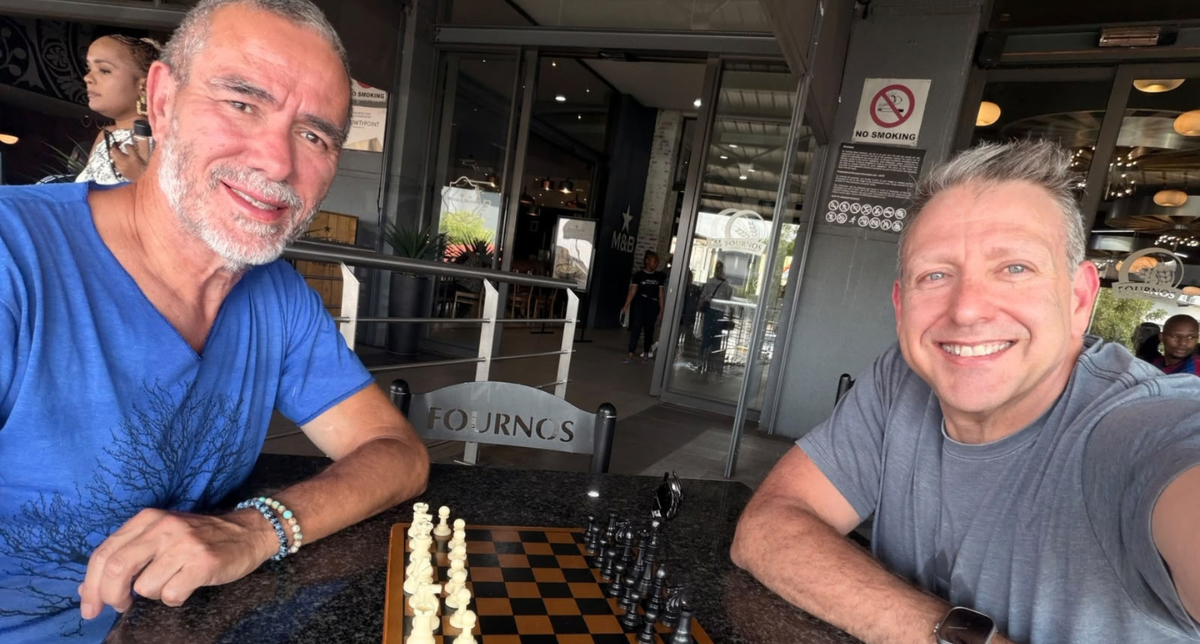
Me and one of my clients, David Green from SwitchOnIT playing chess on Saturday
I clearly am not thinking hard enough. I lose more games than I win, and I can go nuclear when I make a move that inevitably sets me up to lose. I make those often.
I need to talk to my therapist about my masochistic streak. Why would I voluntarily put myself through that? Come to think of it, we should discuss my padel games too.
I reckon I put on weight after chess. But that's the comfort eating to soothe myself after botching the game.
Still, let's be generous and entertain the idea that heavy thinking might contribute to weight loss.
If it does, outsourcing our thinking to AI could be bad news for our waistlines.
Many of us hand our thinking over to AI, especially with writing. We give the result a cursory edit, if that, and send it out.
AI can be unbelievably mischievous. It slips in a sentence that sounds fine but makes no sense in the article. Unless you're paying attention, out it goes under your name.
You really have to go through the thing with a fine-tooth comb. Does that sentence belong? Is it true? Is that even what you wanted to say?
And I'm not just talking about writing. I don't think we give ourselves enough time to think about much at all. When we get a gap, we fill it with Netflix, social media or random kak.
We reach for something to watch or scroll through before we've even sat with our own thoughts.
Perhaps Donald Trump should have gone with Make Thinking Great Again instead of Make America Great Again.
Might have come in handy before the roughly R3-a-litre fuel hike forecast for next week.
Use AI, of course. Just don't subordinate your thinking to it. Let it do some of the heavy lifting. You still need the exercise.
Perhaps This Will Pique Your Interest?
The Niche Between Ninja and Nothing. Wed 7 Oct from 17h00 - 20h30 | The Architecture of Selling | PechaKucha Nights Vol. 43 |
0 comments