He'd been laid off twice.
The second time hit differently.
Not because of the financial pressure. Not even because of the uncertainty. But because somewhere between the recruiter calls that went nowhere and the referrals that fizzled out, he started to wonder if the industry had quietly moved on without him.
That feeling is hard to name when you're in it. It just shows up as low energy in the mornings. A reluctance to open LinkedIn. A slow drift toward "maybe I should just start my own thing." Not because entrepreneurship excites you. But because the job market has stopped feeling like a place that wants you.
Marcus came to me in that place.
Not broken. Not desperate. But quietly deflated in the way that only happens after you've done everything right and still gotten silence.
We talked about the front door. How it works. Why it stops working for experienced designers at a certain level. How the people hiring for senior and lead roles rarely post them publicly until they've already decided internally. How a strong portfolio sent to a recruiter inbox almost never reaches the person who actually makes the call.
Then we talked about the back door.
Not a hack. Not a trick. Just a different way in. One that starts with curiosity instead of applications, and conversations instead of submissions.
Marcus tried it.
One week later, he sent me this:
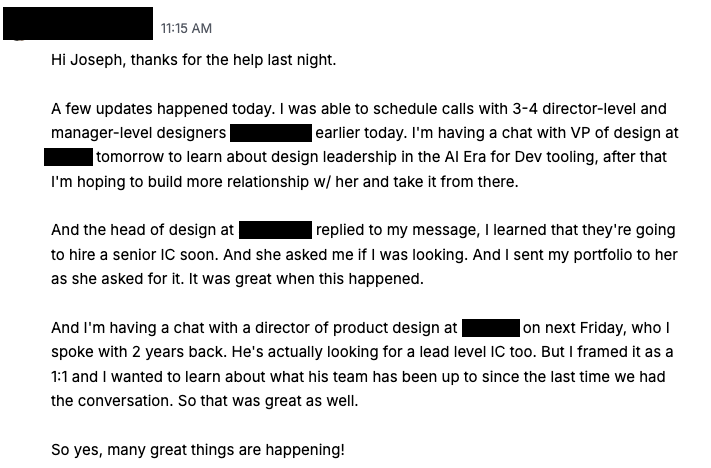
He wasn't asking for jobs. He was asking to learn.
The detail that stuck with me most: he reconnected with a director of product design he'd spoken to two years ago. Framed it as a catch-up. Wanted to hear what the team had been up to.
That director is now looking for a lead-level IC.
He didn't pitch. He caught up. The director volunteered the opening.
That's the whole thing right there.
The week after, another update. The VP he'd spoken to had left her company. But she still wanted to chat. The head of design at another company was in a hiring freeze. But she made a direct intro to a team Marcus had been targeting. That intro turned into a call with the actual hiring manager.
Read that again slowly.
The VP left the company. Still opened a door.
The company is frozen. Still made an intro.
The back door doesn't care if the front door is locked.
What changed for Marcus wasn't his portfolio. It wasn't his resume. It wasn't even his LinkedIn profile.
It was the first message he sent.
That's where it starts. Always. One message to one person. Not asking for a job. Not pitching yourself. Just starting a real conversation with someone worth knowing.
Many designers never send that message. Not because they don't know how. Because they don't know what to say. Because they're afraid it'll come across as desperate. Because they've been burned before and the rejection cost too much.
I built something to help with exactly that.
---
The Outreach Playbook + Coach GPT
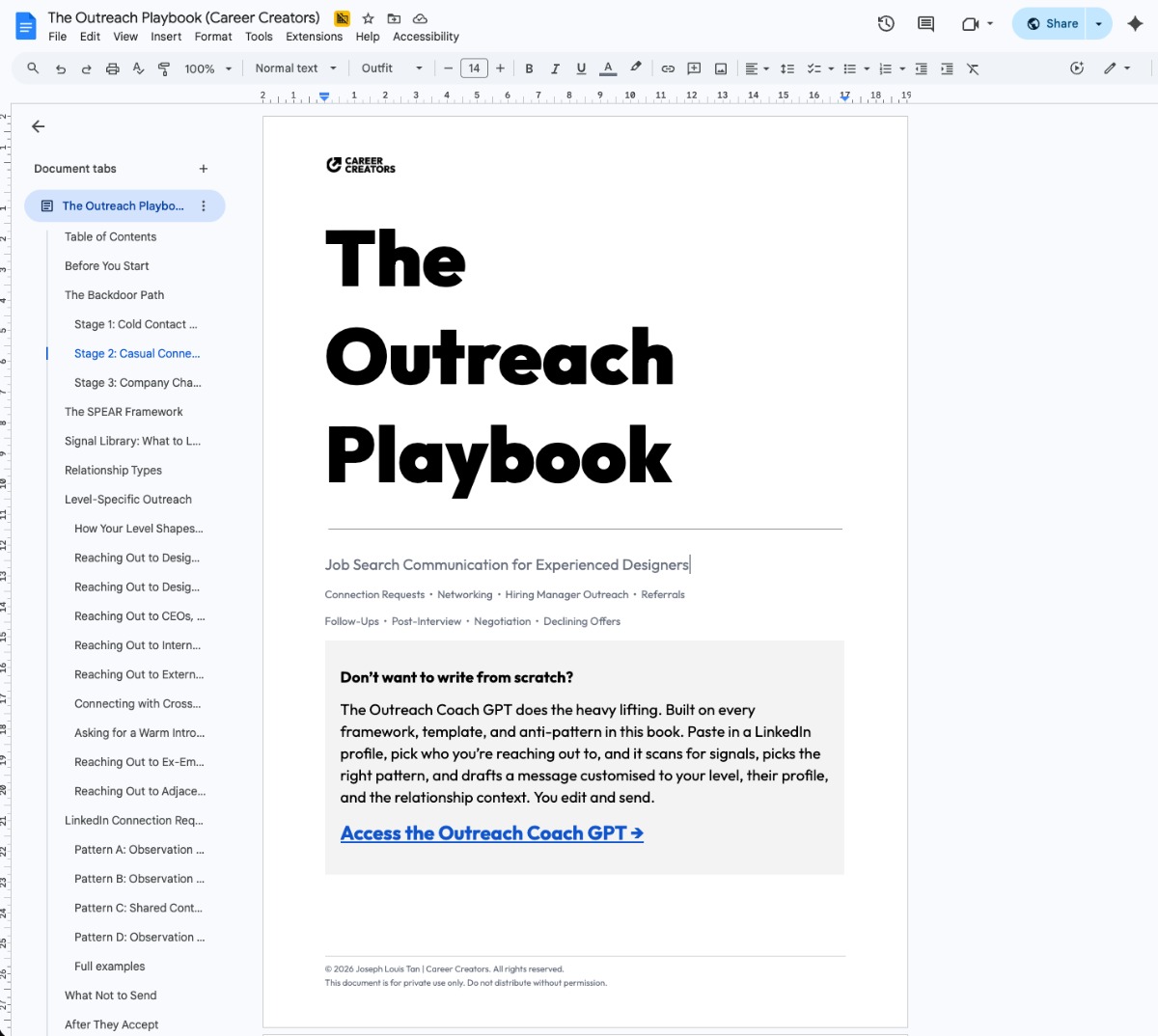
60+ pages of scripts, frameworks, and templates. Covering everything from the first connection request to salary negotiation. Every message type you'll ever need, written for experienced designers.
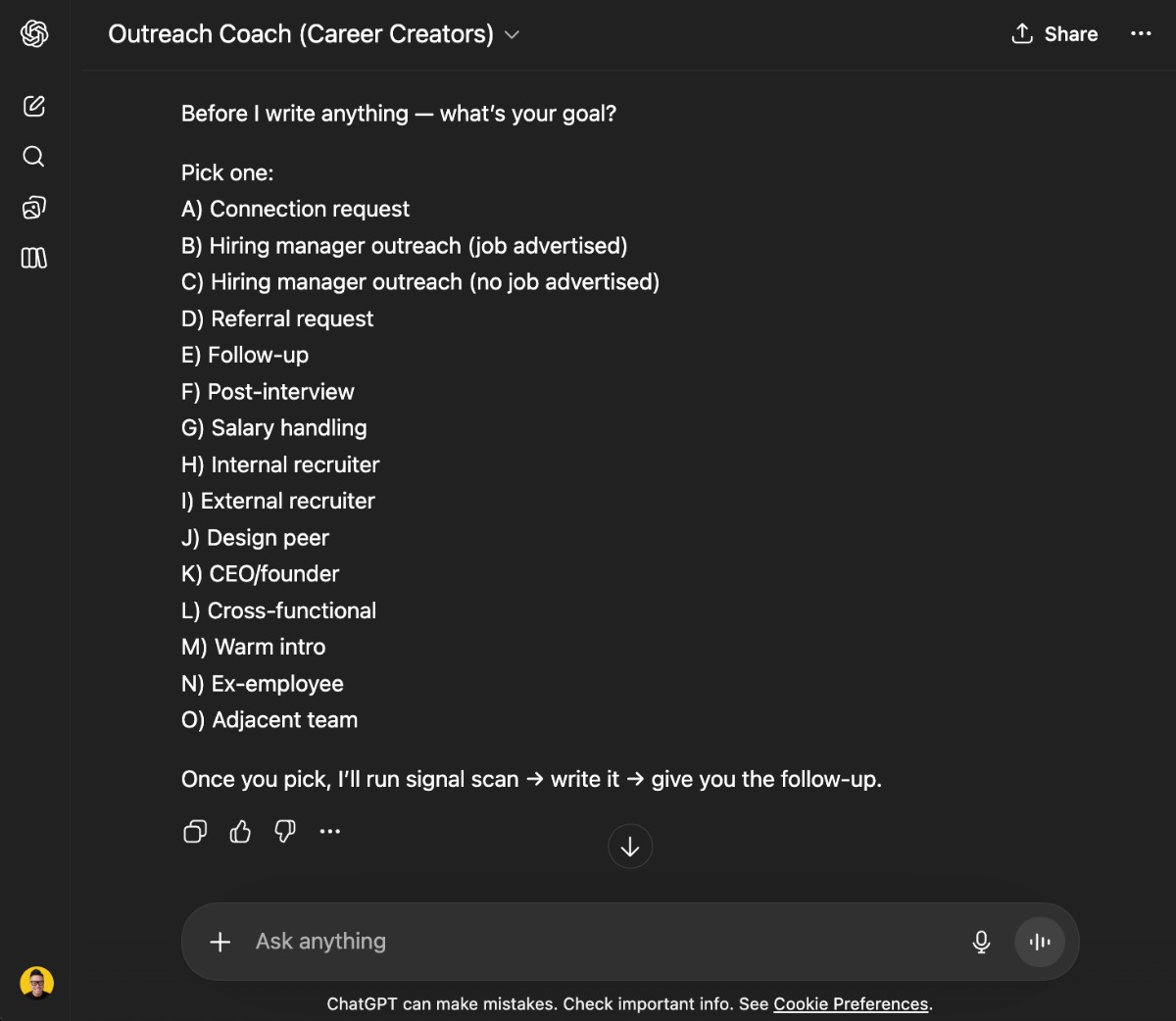
The GPT does the heavy lifting. Paste in a LinkedIn profile, pick who you're reaching out to, and it scans for signals, picks the right pattern, and drafts a message customised to your level, their profile, and the relationship context. You edit and send.
It covers:
- Hiring manager outreach before a role is posted
- Connection requests that get accepted and replied to
- Referral requests that don't feel awkward
- Follow-ups when conversations stall
- Offer negotiations once you get there
Normally $97.
Today, Good Friday, it's $47.
One day only.
https://buy.stripe.com/9B6cN7gGI6ku2T6dX54ow0z
If Marcus's week is the outcome, this is where it starts.
Joseph
0 comments