 New Post from BiteofanApple
The True Expense Of Nature
It's Saturday morning, and you have no plans. Perhaps your schedule happened to line up that way, perhaps the kids are gone, or maybe it's just luck. Regardless, it's glorious. You bask in the glow of a lazy morning while you decide just how you're going to spend today. In your mind you go over different ideas, considering each and its consequences.
You could go to the beach! No, too much effort. You could stay in and read a book, but it's a nice day. You could read outside. Perhaps though it's better to go for a long walk first, grab a coffee maybe? You need to grab some things at the store, and that's on the way. Eventually you arrive at a plan: walk to get coffee, read for a while at the café, then stop by the store on the way home! An excellent plan—efficient and relaxing!
What have you just done? How did you arrive at this decision? There were so many variables, a nearly infinite possibility space, yet you managed to make do. Perhaps Nature itself is not so dissimilar.
Making Decisions
When you make a decision like in the example above, you consider and explore the options you have. Implicitly you ignore certain possibilities—even with a totally free day, few people decide to spend it by committing a whimsical burglary. Instead you narrow down the options by what fits your typical habits and recent situations, and then you imagine how those possibilities might play out, weighing the consequences.
Hopefully you don't get stuck in analysis paralysis, and so, when you finally come to a decision, it's fairly optimal: taking into account your responsibilities, preferences, financial capacity, and mood.
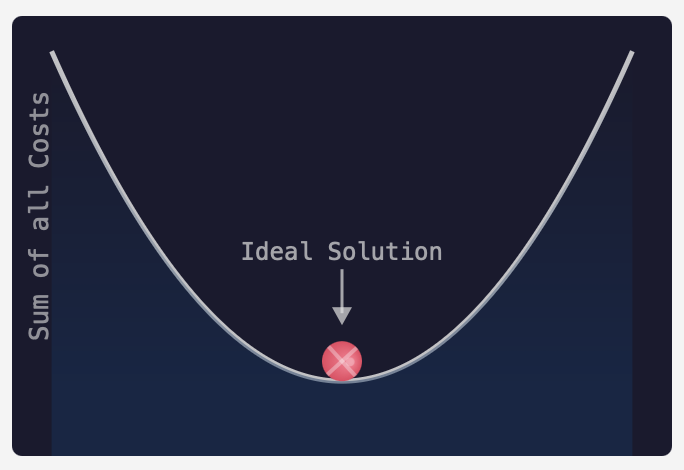
This is a kind of optimization problem, a kind of problem that humans solve, repeatedly, every single day and similar to the kinds that are the subject of Classical Physics. In effect, you're trying to find a path through the world which minimizes the financial, personal, and societal cost. Preferred solutions are not the choices with no cost, as those are very rare, instead they're the solutions with the least cost.
In any given situation, the least costly solution should be the one that's preferred, assuming you've accounted for and weighed every type of cost.1 If we wanted to calculate the optimal solution, perhaps using some calculus, we'd need a single notion, a unit of measure, that could represent any kind of cost and then we'd need a description for how much each decision, each path you might take, might cost. But once we had that, in principle anyway, we could calculate the best option every time.
Let's call this generalized, hypothetical cost Action.
0 comments